


Last reviewed: July 2026
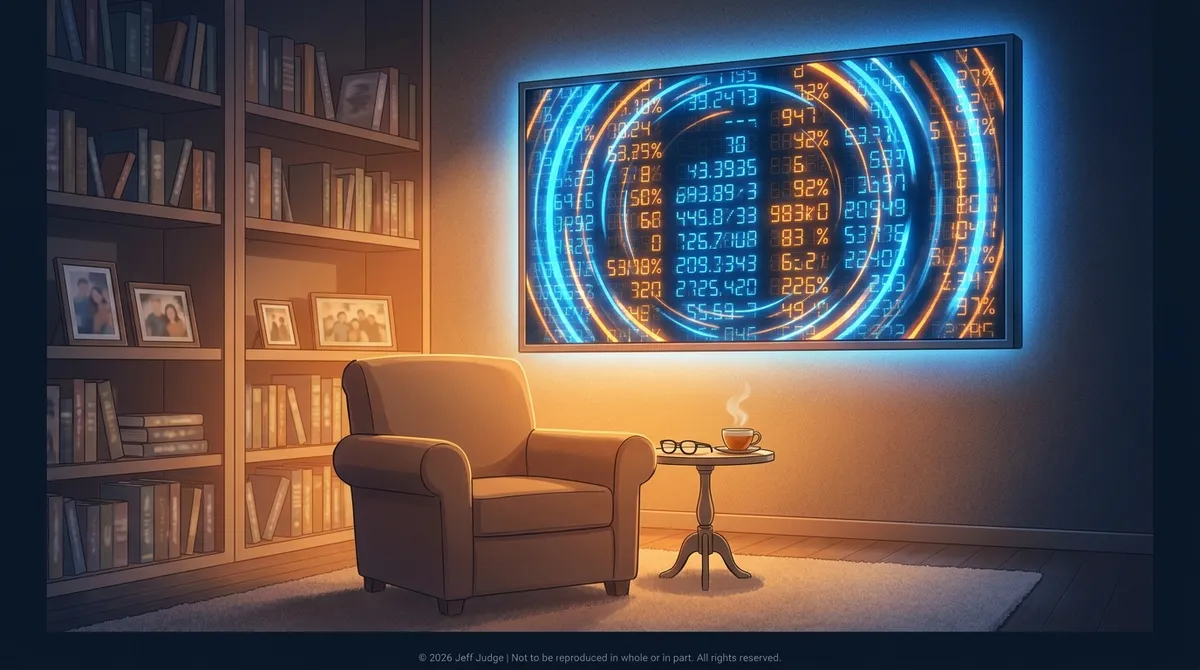
“More” stops being a goal the moment you’ve passed the numbers that actually fund your life and keep accumulating anyway, out of habit rather than need. That’s the scoreboard problem: the balance stopped being a target and became a number you watch for its own sake.
One of the stranger conversations Jeff Judge has with clients is with people who have, by any reasonable measure, already won. They have more than enough. Retirement is funded. Kids are through college. House is paid off. And they’re still anxious. Still checking the portfolio twice a day. Still measuring themselves against a number that keeps moving, always playing another game.
Key Takeaways
- The scoreboard problem is when your account balance stops being a goal and becomes a number you watch out of habit.
- A useful test: if your portfolio fell 20% tomorrow, would anything in your actual life have to change?
- Per the Social Security Administration, the average monthly retirement benefit in 2026 is about $2,071, so the portfolio supplements income, it doesn’t replace it.
- Quarterly portfolio reviews are almost always enough; daily checking adds stress, not information.
- Focus on what you control, savings rate, allocation, spending, and staying invested, not the daily number.
About the Author
About the Author: Jeff Judge, CFP®, AEP®, ChFC®, CLU® is a financial planner who writes Viewpoints for JeffJudgeCFP.com. He helps families and business owners think more clearly about turning a portfolio balance into an actual plan, using the R.U.D.D.E.R. Method™, the financial planning process Jeff developed. “Some of the most anxious investors I meet already won the game years ago. The work is getting them to put the scoreboard down.”
Why Does the Scoreboard Problem Happen?
Investment accounts are designed to feel like scoreboards. The balance changes daily. Percentage gains and losses are displayed prominently. Benchmarks sit in the background. The whole interface is built for engagement, which means it’s built to make you feel like something is always at stake.
That’s appropriate when you’re building toward a goal. It’s actively unhelpful when you’ve reached one.
The scoreboard becomes a habit. People who spent thirty years watching the number go up find it genuinely difficult to stop watching, even when the number no longer needs to go anywhere in particular. The anxiety about the score persists long after the game ends.
There’s also a social dimension. Clients compare themselves to peers, to headlines, to whatever the market returned last quarter. The scoreboard attaches to relative performance, not personal sufficiency. Your portfolio can be doing exactly what it needs to do for your life while “losing” by the scoreboard’s measure. That’s not a financial problem. It’s a framing problem.
Is checking your portfolio daily actually a problem?
On its own, no. It becomes a problem when the daily number starts driving your mood and your decisions instead of your written plan. If a down day makes you want to sell, the checking has stopped being information and started being a trigger.
How Do You Know If You Have the Scoreboard Problem?
Here’s the diagnostic question Jeff runs with clients who show signs of scoreboard thinking: “If your portfolio dropped 20% tomorrow, what would actually change in your life?”
For most people with the scoreboard problem, the honest answer is: nothing immediate. They wouldn’t need to delay retirement. They wouldn’t have to change their spending. The number would be lower, and that would feel terrible, but it wouldn’t change anything real.
The feeling of threat, in those cases, is the scoreboard talking. Not the actual plan.
| Signal | What It Looks Like | What It Means |
|---|---|---|
| Checking more than once daily | Portfolio app is the first thing you open | The balance is running your mood, not your plan |
| Market days affect your mood | Good day = relief; bad day = dread | You’re tracking score, not outcomes |
| You feel “behind” with no target | Can’t name what you’re behind on | Relative thinking has replaced goal thinking |
| Allocation shifts on recent returns | Moved to cash in 2022, back to equities in 2023 | Scoreboard is driving decisions it shouldn’t |
Any one of these is worth paying attention to. All four together is the scoreboard problem running at full speed.
Does having “enough” mean you should stop investing for growth?
No. It means the portfolio’s job shifts from accumulation to durability. You still want growth, but the measure of success becomes whether the plan funds your life, not whether you beat last quarter’s return.
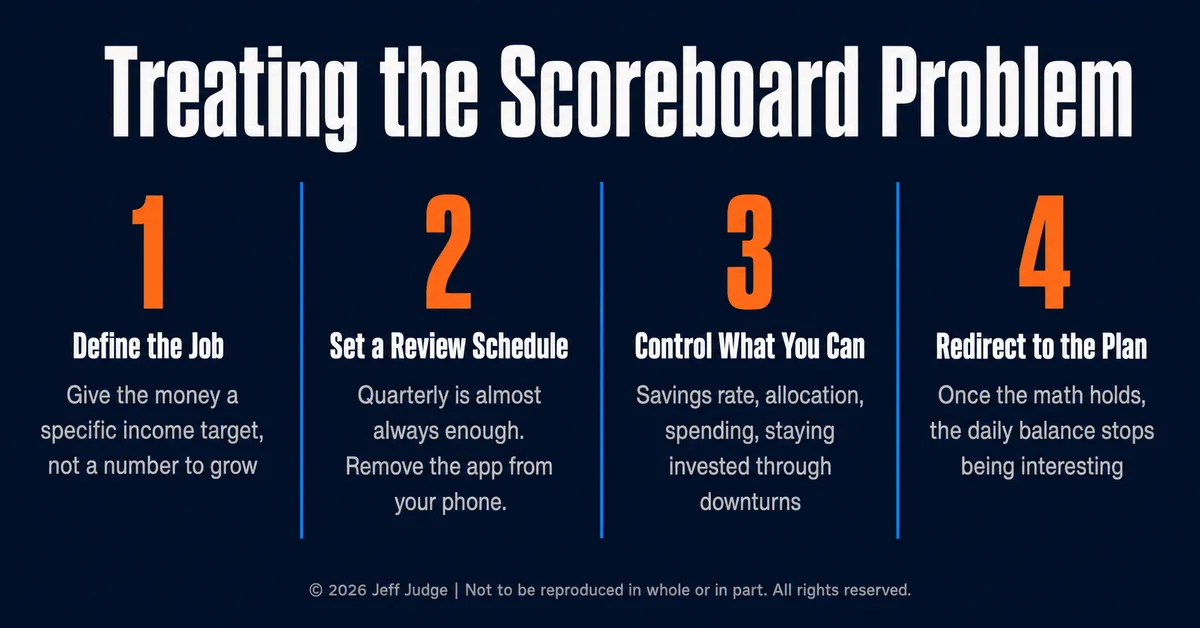
How Do You Treat the Scoreboard Problem?
Step 1: Define what the money actually needs to do
Give the portfolio a specific job. Not “grow as much as possible.” Something concrete: “Fund $7,500 a month in retirement spending, starting at age 64, for 30 years.” A specific job description makes the daily score irrelevant to most decisions.
Per the Social Security Administration, the average monthly retirement benefit in 2026 is approximately $2,071. Most people need their portfolio to supplement that figure to meet actual spending, not replace it entirely. Knowing the exact gap between your Social Security income and your real spending target is the first step in turning a scoreboard into a plan.
Step 2: Set a review schedule and stick to it
Quarterly reviews are almost always sufficient for long-term investors. Monthly is reasonable for people in early retirement. Daily reviews serve almost no useful purpose and mostly add stress without useful information. Remove the app from your home screen if you need to.
Step 3: Separate what you can control from what you can’t
You control your savings rate, your allocation, your spending, and whether you stay invested during downturns. You don’t control daily market returns, inflation, or what your neighbor’s portfolio did. Scoreboard thinking conflates these categories. Sound planning puts your attention on the controllable variables.
| Controllable | Not Controllable |
|---|---|
| Savings rate | Daily market returns |
| Asset allocation | Inflation rate |
| Withdrawal timing | Interest rate decisions |
| Spending decisions | Sequence of returns |
| Whether you stay invested | What your neighbor earned |
Step 4: Redirect attention from the balance to the plan
What does the balance need to produce? What’s the actual spending rate? What’s the risk you genuinely can’t afford to take? Once those questions have concrete answers, the daily balance becomes much less interesting. Which is exactly where you want it.
Frequently Asked Questions
What is the scoreboard problem in investing?
The scoreboard problem is when your account balance stops being a goal and becomes a number you watch for its own sake. It usually hits people who have already funded their goals but keep measuring success by daily market movements instead of by their plan.
How often should I check my investment portfolio?
For most long-term investors, quarterly is plenty, and early retirees rarely need more than monthly. Daily checking adds stress without adding useful information, and it tends to push people toward reactive decisions during volatile stretches. Removing the app from your home screen helps.
I have enough money but still feel anxious about investing. Why?
Anxiety after reaching your goals usually comes from habit, not math. After decades of watching the number climb, the watching itself becomes hard to stop. The feeling of threat is often the scoreboard talking, not a real risk to your actual plan.
What should I focus on instead of my account balance?
Focus on what you control: your savings rate, your asset allocation, your spending, and whether you stay invested through downturns. Give the portfolio a specific job, fund a defined spending target, and the daily balance becomes far less interesting to track.
What Is the Goal of Financial Planning?
The goal isn’t a large number. It’s a plan that works under realistic conditions, that you understand well enough to stick with, and that gives you the specific confidence of knowing the math holds.
The people who sleep well aren’t the ones with the most money. They’re the ones who stopped watching the scoreboard because they know their plan doesn’t depend on today’s score. That’s a meaningful distinction, and it doesn’t happen by accident.
If you can describe, in plain English, what your portfolio needs to produce and when, and the math holds even in a rough market, the daily balance stops being interesting. That’s the treatment.
Schedule a no-obligation call with Jeff to build the plan that makes the scoreboard irrelevant.
The information provided is for educational purposes only and should not be construed as investment advice. Investment strategies should be tailored to individual circumstances, risk tolerance, and goals. Past performance doesn’t guarantee future results. Consult with qualified financial professionals regarding your specific situation. Securities offered through LPL Financial, Member FINRA/SIPC. Investment advice offered through Great Valley Advisor Group, a registered investment advisor and separate entity from LPL Financial. © 2026 JeffJudgeCFP.com | Not to be reproduced in whole or in part. All rights reserved.