



Last reviewed: July 2026
Required minimum distributions are the federal government’s way of collecting on the tax deal you made when you saved in a traditional IRA or 401(k). Starting at age 73 under IRS SECURE 2.0 rules, you must withdraw a calculated amount from your pre-tax accounts every year. The amount is set by a formula. You don’t get to negotiate it. And if you’ve never run the projection before that birthday arrives, the tax hit can catch you off guard.
Key Takeaways
- Per the IRS, RMDs begin at age 73 under SECURE 2.0 and are taxed as ordinary income, with no option to negotiate.
- At 73 the Uniform Lifetime Table factor is 26.5, so a $1,000,000 IRA forces about a $37,700 first-year withdrawal.
- RMDs stack on Social Security and pensions; up to 85% of benefits become taxable above $44,000 of combined income.
- Converting $100,000 a year for five years can cut a first-year RMD by roughly $18,900, every year after.
- Missing an RMD triggers a 25% IRS excise tax, reduced from 50% under SECURE 2.0.
About the Author
About the Author: Jeff Judge, CFP®, AEP®, ChFC®, CLU® is a financial planner who writes Viewpoints for JeffJudgeCFP.com. He helps families and business owners project RMDs years ahead and shrink the balance with conversions before age 73 forces the issue, using the R.U.D.D.E.R. Method™, the financial planning process Jeff developed. “Most people first run the RMD math the year it hits. Start the projection in your early 60s and you still have a decade to change the outcome.”
What Are the Required Minimum Distribution Rules for 2026?
Most people know RMDs exist. Fewer understand the calculation, the income-stacking effect, or what could have been done about it years earlier.
What are required minimum distributions?
An RMD is the minimum amount the IRS requires you to withdraw annually from a traditional IRA, 401(k), 403(b), or most other pre-tax retirement accounts. Under the SECURE 2.0 Act, the mandatory start age is now 73. You pay ordinary income tax on every dollar you withdraw.
How is the RMD amount calculated?
Divide your December 31 account balance by your life expectancy factor from the IRS Uniform Lifetime Table. At age 73, that factor is 26.5. A $1,000,000 traditional IRA produces a first-year RMD of approximately $37,700. At age 80, the factor drops to 20.2, so that same $1,000,000 balance produces roughly $49,500. Accounts that grow faster than you withdraw produce larger and larger RMDs year over year.
What happens if I miss an RMD?
The IRS imposes a 25% excise tax on any amount you should have withdrawn but didn’t. SECURE 2.0 reduced this from the prior 50% penalty. A correction window may reduce the penalty further, but navigating it is not something you want to do from a standing start. Don’t find out how the correction process works by accident.
Does the RMD amount change each year?
Yes. The calculation resets annually using your updated December 31 balance and your current age factor from the IRS table. There is no cap. If your portfolio grows faster than the distributions require, your RMD obligation grows with it.
How do RMDs stack with your other retirement income?
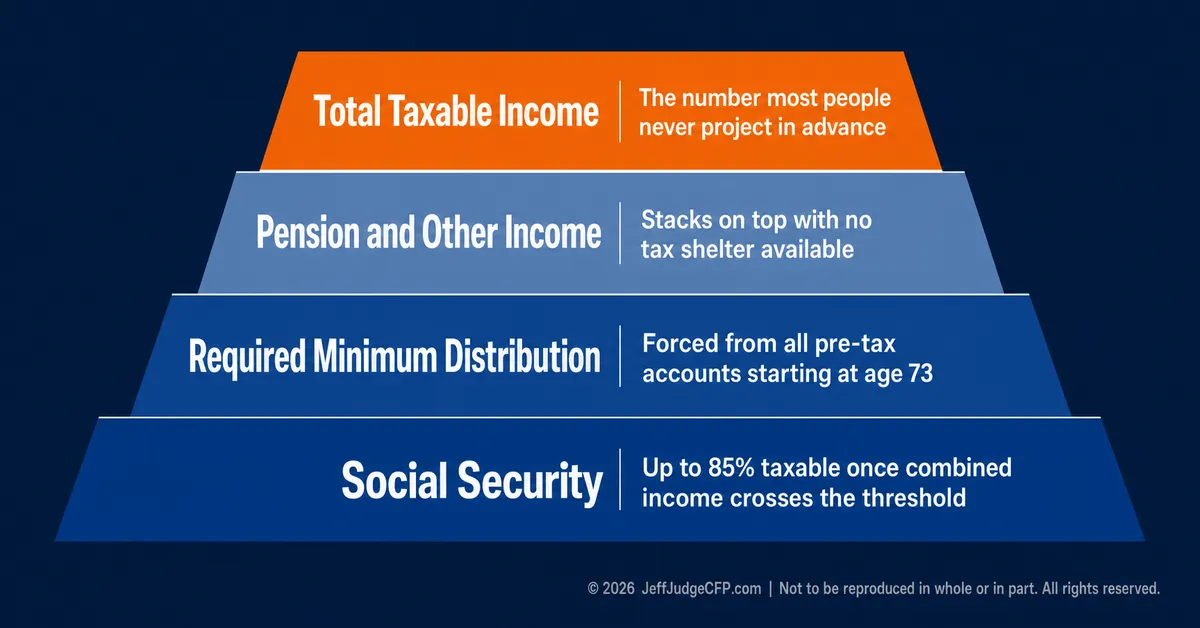
The real problem with required minimum distributions isn’t the withdrawal amount in isolation. It’s where that amount lands in your total income picture.
Consider a married couple retiring in their late 60s. They have Social Security income, perhaps a pension or rental income, and expected IRA withdrawals. Before the first mandatory distribution at 73, they may already have $40,000 to $70,000 in annual gross income. Now add a $50,000 RMD from a $1.3 million pre-tax account. That combined income figure could push them into the 22% federal bracket or higher.
The stacking problem doesn’t stop there. Per IRS rules, up to 85% of Social Security benefits can become taxable once combined income exceeds $44,000 for a married couple filing jointly. And according to Social Security Administration data, if a retiree’s combined income crosses Medicare IRMAA thresholds, they pay surcharges on Part B and Part D premiums that can run into the hundreds of dollars per month.
Most people haven’t run this combined income projection before their first RMD hits. That’s not a planning oversight. It’s a math problem waiting to become an expensive one.
Why is the stacking effect of RMDs the real problem?
Because the RMD rarely lands alone. It piles on top of Social Security, a pension, and other income, which can lift you into a higher bracket, make up to 85% of your Social Security taxable, and trigger IRMAA surcharges. The combined total, not the withdrawal by itself, is what hurts.
Why is the window to act shorter than most people think?
The best time to address RMDs isn’t the year before they start. It’s the five to ten years before. The gap between leaving a paycheck and turning 73 is frequently the lowest-income window of your retirement. That’s when Roth conversions are most effective.
Converting pre-tax IRA money to a Roth during these lower-income years shrinks the balance subject to future RMDs. Roth IRAs have no RMD requirements during the account owner’s lifetime. Every dollar converted now is a dollar the IRS can’t force you to take out later.
The calculation isn’t complicated. Convert $100,000 per year for five years. You’ve reduced your RMD base by $500,000. The first-year RMD on a $1,000,000 balance instead of $1,500,000 is roughly $18,900 less. Per year. Compounded across a 20-year retirement, that’s a material reduction in forced taxable income.
The catch is timing. If you wait until 72 to look at this, you have one year. If you start at 62, you have a decade. The leverage is in the window.
How do Roth conversions before 73 lower future RMDs?
Every dollar you convert leaves the pre-tax balance the RMD formula draws from, and Roth IRAs have no lifetime RMDs. Convert $100,000 a year for five years and you shrink the RMD base by $500,000, cutting a first-year RMD on a $1,000,000 balance by roughly $18,900.
What can you do about RMDs before the IRS forces the issue?
Run the projection now. Pull your current pre-tax account balances. Apply a conservative growth estimate. Project the balance to age 73. Divide by 26.5. That’s your estimated first-year RMD under the IRS Uniform Lifetime Table. Layer on expected Social Security, pension, and other income. Look at the total.
Does the combined number push you into a higher bracket? Does it cross IRMAA thresholds? Per IRS rules, does it trigger additional taxation of Social Security? These are calculable questions, not estimates. You have the inputs you need.
This projection should be updated every year during the pre-retirement window, not just once. Account balances change. Income sources shift. The right answer at 62 may not be the right answer at 67.
Frequently Asked Questions
At what age do required minimum distributions start?
Per the IRS, under SECURE 2.0 the mandatory start age is 73. Each year you must withdraw a minimum from traditional IRAs, 401(k)s, 403(b)s, and most pre-tax accounts, and you pay ordinary income tax on every dollar. There is no option to skip or negotiate the amount.
How do you estimate your first RMD?
Project your pre-tax balance to age 73, then divide by the IRS Uniform Lifetime Table factor of 26.5. A $1,000,000 balance produces about a $37,700 first-year RMD; by 80 the factor falls to 20.2, raising the same balance’s RMD to roughly $49,500.
What is the penalty for missing an RMD?
The IRS charges a 25% excise tax on any amount you should have withdrawn but didn’t, reduced from 50% under SECURE 2.0. A correction window can lower it further, but the process is cumbersome. It is far easier to take the distribution on time than to fix a miss.
How does the 10-year rule affect heirs?
Per the SECURE Act, most non-spouse heirs who inherit an IRA after 2019 must empty it within 10 years, with distributions taxed as ordinary income. A 45-year-old inheriting a $600,000 IRA faces that during peak earning years. Lifetime Roth conversions can leave a more tax-efficient inheritance.
How does the 10-year rule make this problem worse for heirs?
One more piece of the RMD picture that often gets overlooked: what happens to the account when you die.
Under the SECURE Act, most non-spouse beneficiaries who inherit an IRA after 2019 must empty it within 10 years. Per IRS rules, the stretch IRA option that allowed heirs to take small distributions over a lifetime is gone for most people. A 45-year-old child inheriting a $600,000 IRA must distribute the entire balance within a decade. Those distributions are taxed as ordinary income. For many heirs, this hits during peak earning years.
This changes how large pre-tax balances fit into an estate plan. A Roth conversion strategy that reduces the pre-tax balance during your lifetime gives your heirs a more tax-efficient inheritance. It also reduces the required minimum distributions you’ll deal with during retirement.
Managing required minimum distributions is part of the planning conversation if you have significant IRA assets and heirs who will inherit them. Most people don’t know the 10-year rule applies until after the original account owner has passed.
If you haven’t run the numbers yet, start with the simple projection above. Schedule a no-obligation call with Jeff when you’re ready to walk through it with someone who runs this analysis for clients regularly.
The information provided is for educational purposes only and should not be construed as investment advice. Investment strategies should be tailored to individual circumstances, risk tolerance, and goals. Past performance doesn’t guarantee future results. Consult with qualified financial professionals regarding your specific situation.
Securities offered through LPL Financial, Member FINRA/SIPC. Investment advice offered through Great Valley Advisor Group, a registered investment advisor and separate entity from LPL Financial.
© 2026 JeffJudgeCFP.com | Not to be reproduced in whole or in part. All rights reserved.