



Last reviewed: July 2026
Most retirement plans don’t budget for IRMAA, which is exactly why it lands as a surprise. IRMAA, the Income-Related Monthly Adjustment Amount, is a Medicare surcharge added to your Part B and Part D premiums once your income crosses a threshold. For 2026, per the Social Security Administration, the first tier begins above modified adjusted gross income (MAGI) of $109,000 for single filers and $218,000 for married couples filing jointly (based on 2024 tax returns). The catch most retirees miss is the timing: the income that triggers IRMAA comes from your tax return two years prior, so the decisions you make in 2024 show up in your Medicare bill in 2026.
That two-year lookback turns routine financial moves into Medicare cost triggers. A Roth conversion, a capital gain from a business exit, an RMD that landed on top of part-time income: any of these can push you into a higher IRMAA tier for a year or two, even if your ongoing retirement income is much lower. Most people encounter this for the first time when the notice arrives.
Key Takeaways
- IRMAA is a Medicare surcharge added to Part B and Part D premiums once your income tops a set threshold.
- For 2026, the first IRMAA tier begins above MAGI of $109,000 single or $218,000 married filing jointly.
- IRMAA uses a two-year income lookback, so 2024’s return drives your 2026 Medicare premium.
- RMDs, capital gains, and Roth conversions feed MAGI; Roth distributions and municipal interest do not.
- The 2026 Part B premium climbs from a $202.90 base to as much as $689.90 per person at the top tier.
About the Author
About the Author: Jeff Judge, CFP®, AEP®, ChFC®, CLU® is a financial planner who writes Viewpoints for JeffJudgeCFP.com. He helps families and business owners put IRMAA projections next to Social Security and RMD estimates so the Medicare budget isn’t understated, using the R.U.D.D.E.R. Method™, the financial planning process Jeff developed. “IRMAA isn’t a reason to avoid Roth conversions or gain management. It’s a real cost that belongs in the model, not a surprise on the notice.”
What does the IRMAA surcharge actually cost?
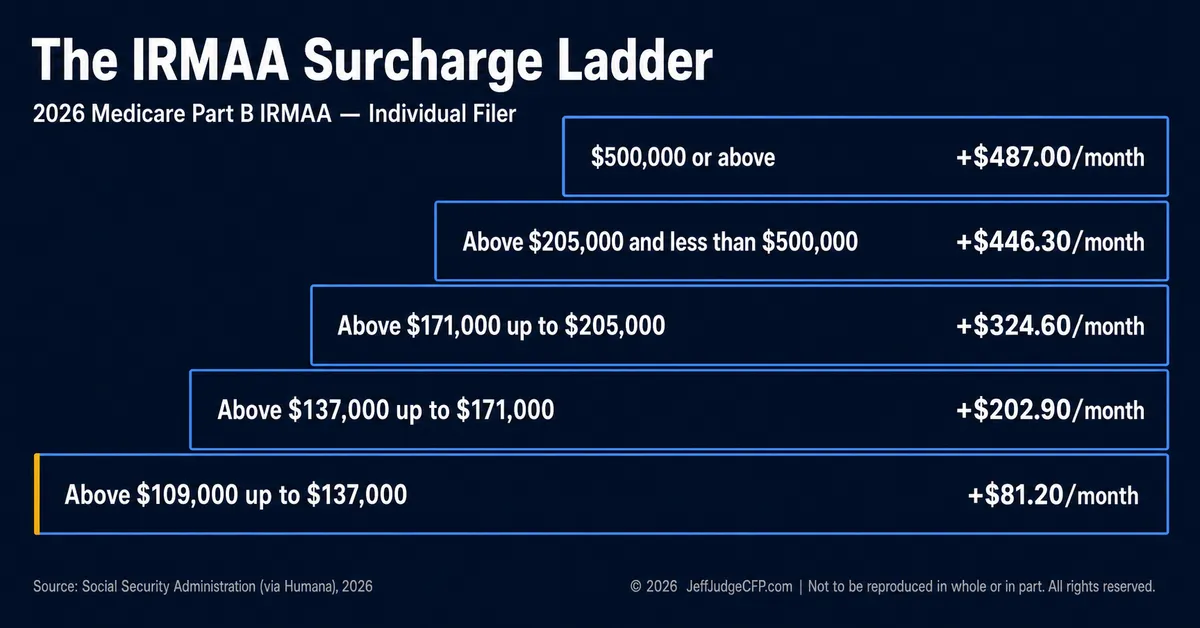
IRMAA operates on five tiers above the base Medicare premium. For 2026, per the Social Security Administration, the standard Part B premium is $202.90/month for individuals with MAGI of $109,000 or less (or $218,000 or less for married couples filing jointly). At the highest tier, the Part B premium reaches $689.90/month per person, before Part D IRMAA amounts.
For most retirees, the relevant number is tier one or two. But the range of that exposure is meaningful. For 2026, moving from the base bracket into the next bracket changes the monthly Part B premium from $202.90 to $284.10 per person. Higher brackets rise from $405.80 to $527.50 to $649.20, up to $689.90 per person (before any Part D IRMAA). These aren’t numbers that show up in a standard retirement income projection, but they’re real costs that affect your net cash flow for a year (or longer, depending on the income pattern).
What is the two-year lookback, and why does it catch retirees off guard?
The mechanism is the part nobody explains well. Medicare uses your most recent tax return on file when you enroll. In 2025, that’s your 2023 return. The Social Security Administration applies the income from that return to determine your premium for the current calendar year.
This creates a structural lag that surprises retirees who had one high-income year. You retired at the end of 2023. Your 2023 income included six months of full salary plus a deferred compensation payout. You enrolled in Medicare in 2025 and discovered your premiums were based on that combined 2023 figure, not your 2024 or 2025 retirement income.
The IRS does provide a mechanism for appeal. If you’ve had a qualifying life change (retirement, reduction in work hours, loss of pension, divorce, death of spouse) that reduced your income since the tax year being used, you can file a life event appeal with Social Security using Form SSA-44. The process works, but it requires documentation and most retirees don’t know to initiate it.
Can you appeal an IRMAA surcharge after a drop in income?
Yes, after a qualifying life change. If retirement, reduced work hours, loss of a pension, divorce, or a spouse’s death cut your income since the tax year being used, you can file Form SSA-44 with Social Security. A one-time capital gain that won’t repeat may not qualify, so check the criteria.
What income feeds IRMAA, and what doesn’t?
Not every dollar in your retirement affects IRMAA equally. Modified adjusted gross income for IRMAA purposes includes wages and salaries, taxable Social Security benefits, required minimum distributions from traditional IRAs and 401(k)s, capital gains, qualified dividends, and Roth conversion amounts.
What it does not include: Roth IRA and Roth 401(k) distributions, return of basis from nondeductible IRA contributions, annuity principal repayments, and municipal bond interest. This is the structural argument for building a Roth balance before retirement. A dollar pulled from a Roth doesn’t feed IRMAA. A dollar taken from a traditional IRA does, and it also increases the portion of your Social Security benefit that’s taxable under provisional income rules.
Do Roth withdrawals count toward IRMAA?
No. Qualified Roth IRA and Roth 401(k) distributions do not count in the MAGI that determines IRMAA, and neither does municipal bond interest or a return of basis. That is a core reason to build Roth balances before retirement: they let you fund spending without lifting your Medicare premium.
The interaction between RMDs, Social Security taxation, and IRMAA is one of the most consequential tax planning questions in retirement, and it’s almost entirely determined by decisions made in the years before and just after you stop working.
How does IRMAA change your Roth conversion math?
If you’re doing Roth conversions in your 60s, and you should at least be modeling them, the IRMAA tier boundaries function as soft cost thresholds in your conversion strategy. Converting $40,000 per year is a different calculation than converting $150,000 per year when the second amount crosses an IRMAA tier.
The math to run: compare the tax you pay on the conversion today (at your current bracket) against the tax you avoid on future distributions and RMDs, then net out any IRMAA surcharges incurred for the two years after the conversion year. For most people in the gap years between retirement and RMD onset, Roth conversions that stay below the first IRMAA threshold are straightforward wins. Conversions that cross into tier two or three require a more explicit calculation.
This doesn’t mean stop converting. It means the tier boundaries are inputs to the decision, not stop signs.
Frequently Asked Questions
What is IRMAA?
IRMAA, the Income-Related Monthly Adjustment Amount, is a surcharge added to Medicare Part B and Part D premiums when income exceeds a threshold. For 2026, the first tier begins above MAGI of $109,000 for single filers and $218,000 for couples filing jointly, based on 2024 tax returns.
How much can IRMAA add to Medicare premiums?
A meaningful amount. For 2026, the Part B premium rises from a $202.90 base to $284.10 at the first surcharge tier and climbs through higher tiers to $689.90 per person at the top, before any Part D IRMAA. Those costs rarely appear in a standard retirement projection.
Why does IRMAA use a two-year lookback?
Medicare sets premiums from your most recent tax return on file, which is two years old. So 2024 income determines 2026 premiums. A single high-income year, from a sale, deferred pay, or a large RMD, can raise premiums even after your ongoing income has dropped.
How do you plan around IRMAA in retirement?
Treat the tier boundaries as soft cost thresholds. Keep income under the first tier when you can, time large Roth conversions and gains with the brackets in mind, and build Roth assets that fund spending without raising MAGI. If a life change cut your income, file Form SSA-44.
What should you do if IRMAA has already hit?
If you receive an IRMAA determination notice and your income has dropped significantly since the tax year being used, file a life event appeal. The form is SSA-44, available from the Social Security Administration. If your income dropped because you retired, that qualifies. If it dropped because of a one-time capital gain event that won’t repeat, it may not qualify as a life change, but it’s worth understanding the current-year trajectory.
If you’re planning ahead, the leverage points are: keeping income below the first IRMAA tier when possible, timing large conversions or gain recognitions with the IRMAA brackets in mind, and building Roth assets that can be distributed without affecting MAGI.
IRMAA isn’t the reason to avoid Roth conversions or delay capital gains management. It’s a real cost that belongs in the model. If your retirement income plan doesn’t include IRMAA projections alongside Social Security and RMD estimates, your Medicare budget is probably understated. Schedule a no-obligation call with Jeff.
The information provided is for educational purposes only and should not be construed as investment advice. Investment strategies should be tailored to individual circumstances, risk tolerance, and goals. Past performance doesn’t guarantee future results. Consult with qualified financial professionals regarding your specific situation. Securities offered through LPL Financial, Member FINRA/SIPC. Investment advice offered through Great Valley Advisor Group, a registered investment advisor and separate entity from LPL Financial. © 2026 JeffJudgeCFP.com | Not to be reproduced in whole or in part. All rights reserved.