



Last reviewed: July 2026
The conventional wisdom on pre-retirement tax planning is to wait until you retire and then sort it out. That’s the wrong sequence. Some of the most effective tax reduction strategies available in retirement only work, or only work well, in the three to seven years before you stop working. Once you’re in distribution mode, the leverage points shift and the setup work is largely done. The decisions made in the final working years set the tax structure you’ll live with for the next two decades.
Key Takeaways
- The highest-leverage retirement tax moves are set up in the three to seven years before you stop working.
- Per the IRS, ages 60 to 63 can contribute up to $35,750 to a 401(k) in 2026 under SECURE 2.0; ages 50 to 59, $32,500.
- Maximizing contributions in the final five years can shelter roughly $162,500 to $175,500 of income.
- HSAs offer a rare triple tax advantage, but eligibility ends when you enroll in Medicare, generally at 65.
- Per the IRS, RMDs begin at age 73, so Roth conversions in your 60s shrink the balance that later forces taxable income.
About the Author
About the Author: Jeff Judge, CFP®, AEP®, ChFC®, CLU® is a financial planner who writes Viewpoints for JeffJudgeCFP.com. He helps families and business owners use the final working years to set a tax structure that holds up for the next two decades, using the R.U.D.D.E.R. Method™, the financial planning process Jeff developed. “Done right, the pre-retirement years become your most productive planning years. Skipped, they lock in a tax structure you set before you knew enough to question it.”
Which tax moves pay off most in the pre-retirement window?
These four moves have one thing in common: they’re more effective, or exclusively effective, while you’re still earning a salary.
1. Maximum 401(k) contributions with catch-up, especially ages 60 to 63
According to the IRS, employees aged 60 to 63 can contribute up to $35,750 to a 401(k) in 2026, reflecting the enhanced catch-up provision introduced under SECURE 2.0 that allows this age group to defer an additional $3,250 above the standard catch-up. Employees 50 to 59 can contribute $32,500. These contributions reduce taxable income dollar-for-dollar in the year made. A high earner maximizing contributions in the final five working years may shelter $162,500 to $175,500 in income over that span. That’s not a rounding error.
2. Roth conversions in years when your effective rate is visible
This sounds counterintuitive. Why convert pre-tax assets while still earning income? Because the pre-retirement years are often the last time your marginal rate is predictable and your income is controllable. Before you retire, you know your W-2. After retirement, income becomes a mix of Social Security (partially taxable depending on provisional income), RMDs (fully taxable), capital gains, and Roth distributions. The window where you can deliberately size a conversion and see the tax effect clearly is narrower than most people realize. It doesn’t close at retirement, but it gets more complicated.
3. Tax-loss harvesting in a taxable portfolio
The last working years are often when taxable portfolios are largest, and the potential losses to harvest are most meaningful. Realized losses now offset future capital gains, including gains from selling appreciated positions at or after retirement. If your taxable portfolio has positions that have declined from cost basis, realizing those losses before they recover creates tax credits you carry forward indefinitely. This requires active management, but the math is straightforward and the benefit compounds.
4. HSA maximization while eligible
Health Savings Accounts are the only account with three tax advantages: contributions are pre-tax, growth is tax-free, and qualified withdrawals are tax-free. The eligibility window closes when you enroll in Medicare, which is generally required at 65 if you’re on an employer plan, and sometimes earlier. For someone in their 50s or early 60s with a qualifying high-deductible health plan, maximizing HSA contributions in the final working years builds a tax-free pool specifically for healthcare costs in retirement, when healthcare spending tends to increase and IRMAA surcharges add to the bill.
Why max an HSA instead of just another retirement account?
Because the HSA is the only account with three tax breaks at once: pre-tax contributions, tax-free growth, and tax-free withdrawals for qualified medical costs. Eligibility ends when you enroll in Medicare, generally at 65, so the final working years are your last chance to build that healthcare-specific, tax-free pool.
Why does the pre-retirement window close faster than it looks?
Once you retire, certain kinds of income control become harder. Your taxable income becomes a function of Social Security timing (when benefits start, what percentage of benefits counts as taxable income), required minimum distributions (beginning at age 73 per the IRS under SECURE 2.0, scaling with your account balance), and investment income your portfolio generates regardless of whether you ask for it.
Before retirement, your income is more predictable. You have a salary you can model, a contribution capacity you can maximize, and conversion decisions you can time against known earned income. That predictability isn’t a small thing. It’s the foundation of effective tax strategy.
The window matters because the tax structure you create in the final working years is largely what you’re living with in retirement. An account heavily loaded in pre-tax assets looks manageable at $1 million. At $2 million, with RMDs beginning at 73, it generates mandatory taxable income that can push a retiree into higher brackets, trigger larger IRMAA surcharges on Medicare premiums, and increase the percentage of Social Security benefits subject to ordinary income tax.
Why is income harder to control once you retire?
Because it stops being a single salary you can model. In retirement it becomes a mix of Social Security, fully taxable RMDs starting at 73, capital gains, and portfolio income you receive whether you ask for it or not. That predictability you have while working is what makes deliberate tax moves possible.
What is the RMD timing problem nobody plans for?
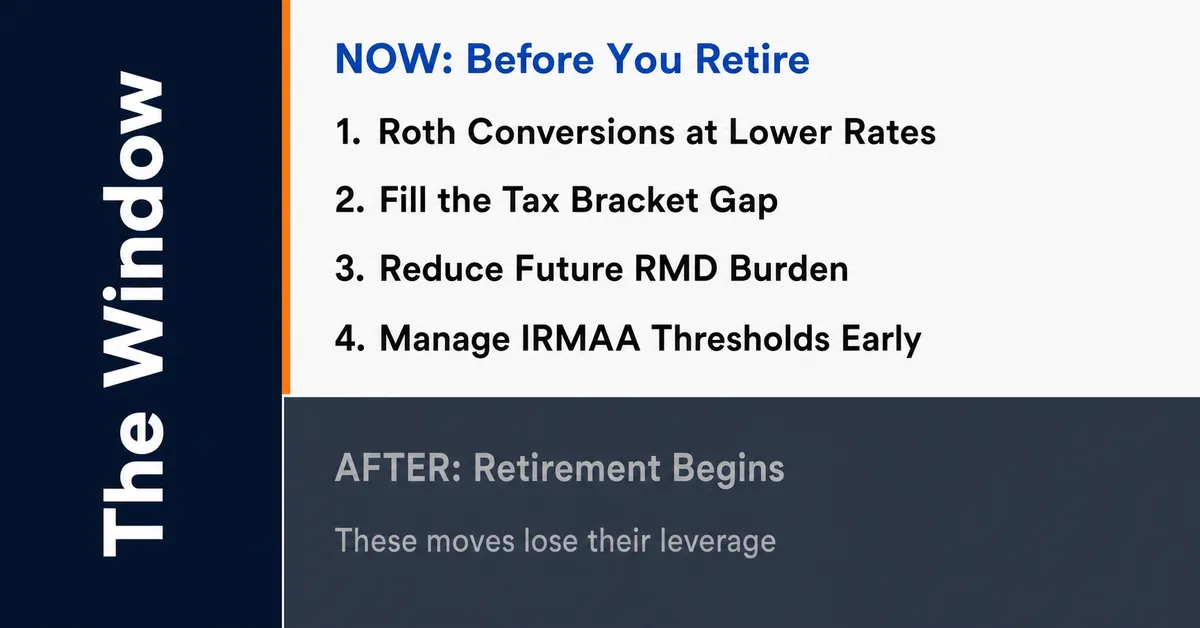
Required minimum distributions from traditional IRAs and 401(k)s begin at age 73. For a retiree who left substantial balances in pre-tax accounts with the intention of managing it in retirement, the actual RMD amounts in their 70s and 80s can be significantly larger than they anticipated when they made that decision.
The setup for managing this problem happens in the 60s. Roth conversions during lower-income years reduce the pre-tax balance that will generate mandatory distributions. The analysis isn’t complicated: how large will my pre-tax accounts likely be at 73? What will the RMD amount be at various balances? What does that amount do to my marginal rate, my Medicare premiums, and the taxability of my Social Security?
Most people don’t have clear answers to those questions when they retire. The ones who run the projection in their early 60s and find a problem still have years to address it. By 72, the options are narrower. By the first RMD, the structure is largely set.
Frequently Asked Questions
Which tax moves only work before you retire?
Several are most powerful while you still earn a salary: maximizing 401(k) contributions with catch-ups, sizing Roth conversions against a known marginal rate, harvesting losses in a large taxable portfolio, and maxing an HSA before Medicare eligibility ends. After retirement, the leverage on each one fades.
How much can you contribute to a 401(k) near retirement?
Per the IRS, under SECURE 2.0 employees aged 60 to 63 can contribute up to $35,750 to a 401(k) in 2026, and ages 50 to 59 up to $32,500. Maximizing those final five working years can shelter roughly $162,500 to $175,500 of income from tax.
Why do Roth conversions matter before RMDs begin?
Per the IRS, RMDs start at age 73 and scale with your balance, forcing taxable income whether you need it or not. Converting in lower-income years during your 60s shrinks the pre-tax balance, which can lower future RMDs, IRMAA surcharges, and the share of Social Security that is taxed.
When should pre-retirement tax planning start?
Ideally three to seven years before you stop working, while income is predictable. That is the window to project your balance at 73, model the RMDs and their bracket, IRMAA, and Social Security effects, and act. By the first RMD, the tax structure is largely locked in.
What should you do with the window while you still have it?
This isn’t a single recommendation. The right combination of moves depends on your income now, your projected retirement income, your account balance mix between pre-tax and Roth, your expected retirement date, and what your advisor has modeled. What the pre-retirement tax planning window means practically is that the five years before you retire deserve more deliberate attention than most people give them.
The questions worth running now: Are you maximizing available contributions across all tax-advantaged accounts? What is your current ratio of pre-tax to Roth balances, and what does that mean for taxable income at 73? Have you stress-tested your retirement income picture against IRMAA tiers and Social Security provisional income thresholds? Does your current plan account for what your tax bracket looks like by decade, not just at retirement?
If most of those answers are vague, the window isn’t closed yet. But it won’t stay open.
Pre-retirement tax planning done right turns the final working years into your most productive planning years. Done wrong, or skipped entirely, it leaves you managing a tax structure in retirement that was largely locked in before you knew enough to question it. Schedule a no-obligation call with Jeff.
The information provided is for educational purposes only and should not be construed as investment advice. Investment strategies should be tailored to individual circumstances, risk tolerance, and goals. Past performance doesn’t guarantee future results. Consult with qualified financial professionals regarding your specific situation. Securities offered through LPL Financial, Member FINRA/SIPC. Investment advice offered through Great Valley Advisor Group, a registered investment advisor and separate entity from LPL Financial. © 2026 JeffJudgeCFP.com | Not to be reproduced in whole or in part. All rights reserved.