


Last reviewed: July 2026
Most financial conversations about a lake house, a vacation property, or a second home focus on whether you can afford the purchase. That’s the wrong question. The right question is what the property will actually cost over its ownership lifetime — and whether that cost is the best use of that capital.
Running that math completely changes what “affordable” means.
What is the true annual cost of owning a vacation home?
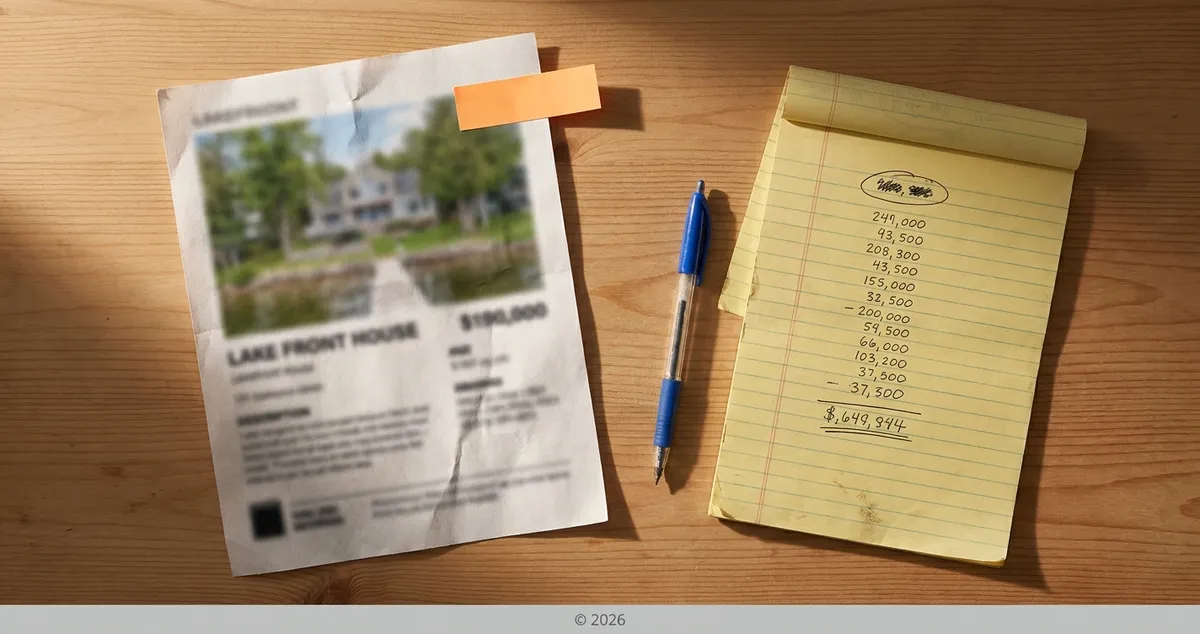
The true annual cost includes mortgage payments, property taxes, insurance, maintenance, utilities, and travel. On a $650,000 lake house with a 20% down payment and a 7% mortgage, the all-in annual cost typically runs $65,000 to $75,000 or more — before factoring in the opportunity cost of the down payment.
Is a vacation home a good investment?
It depends on rental income, appreciation, and personal use patterns. For many buyers, the property costs far more per day of actual use than equivalent rentals would. The IRS also doesn’t allow the primary residence capital gains exclusion on a second home, meaning any appreciation is fully taxable as capital gains.
When does the math favor buying a second home?
The math tilts favorably when the property generates substantial rental income when not in personal use, sits in a market with consistent above-average appreciation, or will be held multigenerationally with lifestyle value shared across many people and many decades.
What’s the opportunity cost of the down payment?
According to historical data, a $130,000 down payment invested in a diversified portfolio with a 7% average annual return grows to approximately $990,000 over 30 years. That foregone growth is a real cost of the purchase, even if it never shows up on a property tax bill.
Key Takeaways
- The real question isn’t whether you can afford a lake house, but what it costs over its ownership lifetime.
- All-in annual cost on a $650,000 lake house typically runs $65,000 to $80,000 before opportunity cost.
- The $130,000 down payment, invested at a 7% average return, could grow to roughly $990,000 over 30 years.
- Renting four weeks a year ($16,000 to $24,000) can cost a fraction of the annual ownership burden.
- A second home gets no primary-residence gains exclusion; gains face 20% federal plus the 3.8% NIIT.
About the Author
About the Author: Jeff Judge, CFP®, AEP®, ChFC®, CLU® is a financial planner who writes Viewpoints for JeffJudgeCFP.com. He helps families and business owners run the full lifetime cost of a second home, including opportunity cost and taxes, before they sign, using the R.U.D.D.E.R. Method™, the financial planning process Jeff developed. “The problem isn’t the lake house. It’s buying it before running the numbers, then learning years later that it costs $70,000 a year to hold.”
What is the real cost of the lake house nobody runs?
A lake house purchased for $650,000. Down payment of $130,000 (20%). Mortgage balance of $520,000 at a 7% rate over 30 years produces a monthly payment of approximately $3,460. That’s $41,500 per year in mortgage payments alone — and for the first decade, the vast majority goes to interest, not equity.
Property taxes on a $650,000 property vary widely by state and municipality, but lakefront markets often carry assessed values that reflect the premium location. A reasonable working estimate across many markets is 1 to 1.5% of assessed value annually — approximately $8,000 per year.
Insurance on a lakefront property runs higher than primary residence coverage. Vacancy periods, water proximity, flood risk, and liability exposure all push premiums up. Per the Insurance Information Institute, secondary and vacation home policies routinely carry surcharges relative to primary residence coverage. A reasonable estimate: $3,500 to $6,000 annually.
Maintenance on a property that sits unoccupied for most of the year costs more, not less. Deferred issues compound. The dock, the HVAC, the roof, seasonal opening and closing, landscaping, and the inevitable repairs that wait until summer visits to get noticed. A working estimate for annual maintenance on a vacation property is 1 to 2% of property value — $6,500 to $13,000 per year.
Add utilities running year-round, furnishings and replacements, and travel costs to and from the property, and the full picture comes into focus.
| Cost Category | Low Estimate | High Estimate | Notes |
|---|---|---|---|
| Mortgage (P&I) | $41,500 | $41,500 | $520K at 7%, 30 years |
| Property taxes | $7,500 | $10,000 | 1–1.5% of assessed value |
| Insurance | $3,500 | $6,000 | Vacation/secondary home rate |
| Maintenance | $6,500 | $13,000 | 1–2% of property value |
| Utilities | $3,000 | $5,000 | Year-round, including off-season |
| Travel & incidentals | $2,500 | $4,500 | Transportation, minor furnishings |
| Annual total | $64,500 | $80,000 | Before opportunity cost |
A conservative, real-world annual cost of $65,000 to $80,000. Most buyers doing the purchase math haven’t assembled these numbers in a single place.
Why is the annual carrying cost so much higher than the mortgage payment?
Because the mortgage is only one line. Property taxes, higher insurance on a secondary home, maintenance that runs more on a property left empty much of the year, year-round utilities, and travel all stack on top. Together they often push the all-in cost to $65,000 to $80,000 a year.
What could that capital do instead?
The $130,000 down payment represents real opportunity cost. Invested in a diversified portfolio earning a historical average of 7% annually, that capital grows to approximately $990,000 over 30 years. That’s not a return on the property — that’s the foregone growth of the money used as the down payment alone.
The ongoing cost differential matters too. If the alternative to owning the lake house is renting one when you want to use it, the math on renting often looks different than most buyers expect. A well-appointed lake house rental for a week in peak season might cost $4,000 to $6,000. If you use your property 4 weeks a year, equivalent rental costs run $16,000 to $24,000 — a fraction of the $65,000 to $80,000 annual ownership cost.

On the tax side, the IRS doesn’t offer a second home the same treatment as a primary residence. When you sell a primary home, you can exclude up to $500,000 of capital gains (married filing jointly). That exclusion doesn’t apply to a vacation property. The full gain is subject to capital gains tax — 20% federal for high earners, plus the 3.8% Net Investment Income Tax, plus applicable state tax.
| Scenario | Purchase Price | Sale Price (15 years) | Gross Gain | Estimated Federal Tax | Estimated After-Tax Gain |
|---|---|---|---|---|---|
| Primary residence | $650,000 | $900,000 | $250,000 | $0 (exclusion applies) | $250,000 |
| Vacation home | $650,000 | $900,000 | $250,000 | ~$59,500 (23.8% rate) | ~$190,500 |
| Vacation home (high-tax state) | $650,000 | $900,000 | $250,000 | ~$75,000+ combined | ~$175,000 or less |
Assumes long-term capital gains rate of 20% + 3.8% NIIT. State taxes vary. Not a tax projection.
A property that appreciates $250,000 over 15 years, while costing $65,000–$80,000 per year to hold, has a very different financial profile than the purchase conversation usually suggests.
When does the lake house math actually work?
None of this means second homes are financially indefensible. Some of the best financial decisions people make don’t optimize purely for return. The question is whether the decision is made with clear eyes.
The math tilts more favorably in specific situations. A property that generates meaningful rental income during weeks or months when it’s not in personal use can change the annual cost picture — though rental income is taxable, and rental activity triggers its own IRS rules on deductibility and passive activity limitations. A property in a market where appreciation has consistently and substantially outpaced carrying costs may justify ownership on economic grounds. And a property that will be held for 30 or 40 years, used by multiple generations, with the lifestyle value distributed across many people and decades — that has a different calculus than a vacation property used 20 days a year by two people.
When does buying a second home actually make financial sense?
When it earns meaningful rental income during the weeks you are not there, sits in a market with consistently strong appreciation, or will be held for decades and used across multiple generations. Spread the lifestyle value across enough people and years and the per-use cost finally looks reasonable.
The problem isn’t the lake house. It’s buying it before running these numbers, then discovering 10 years later that the property requires $70,000 a year to hold and has become a financial anchor rather than a lifestyle asset.
Frequently Asked Questions
How do you calculate the real cost of a vacation home?
Add every recurring cost, not just the mortgage: principal and interest, property taxes, insurance, maintenance, utilities, and travel. On a $650,000 lake house with 20% down at 7%, that typically totals $65,000 to $80,000 a year, before counting the opportunity cost of the down payment.
How are taxes different on a second home sale?
A vacation home gets no primary-residence exclusion. When you sell a primary home you can exclude up to $500,000 of gain if married filing jointly; that does not apply to a second home. The full gain is taxed, 20% federal for high earners plus the 3.8% Net Investment Income Tax.
Is renting a vacation home cheaper than owning one?
Frequently, yes, for light use. A peak-season week might rent for $4,000 to $6,000. Using a property four weeks a year is $16,000 to $24,000 in rentals, a fraction of the $65,000 to $80,000 it costs to own and carry the same home for a year.
What is the cost per day of using a vacation home?
Divide the annual cost by the days you actually use it. A home that costs $70,000 a year and gets used 65 days runs about $1,077 per day. Ask whether you would happily pay that nightly rate to rent; if not, the gap is worth understanding first.
What question should you answer before you buy?
What does this property cost per day that you actually use it?
If the lake house is used 65 days a year — a fairly engaged ownership pattern for a vacation property — and costs $70,000 annually, the cost per actual use day is approximately $1,077.
Would you pay that amount to rent a lake house on every trip? If the answer is no, that gap is worth understanding before signing.
The point isn’t that the lake house is wrong. It’s that the emotional pull of “we’ve always wanted this” tends to arrive before the financial analysis. The analysis is worth doing first — not to kill the decision, but to make it with the full picture in front of you.
Schedule a no-obligation call with Jeff to run the full carrying cost of a second home against your retirement plan.
The information provided is for educational purposes only and should not be construed as investment advice. Investment strategies should be tailored to individual circumstances, risk tolerance, and goals. Past performance doesn’t guarantee future results. Consult with qualified financial professionals regarding your specific situation. Securities offered through LPL Financial, Member FINRA/SIPC. Investment advice offered through Great Valley Advisor Group, a registered investment advisor and separate entity from LPL Financial. © 2026 JeffJudgeCFP.com | Not to be reproduced in whole or in part. All rights reserved.