



Last reviewed: October 2026
If you inherited an IRA and you’re planning to let it sit untouched until the deadline, the inherited IRA 10-year rule is about to cost you more than you think. Most non-spouse beneficiaries have to empty the account by the end of the tenth year after the original owner died, and waiting until that final year stacks a decade of withdrawals into a single tax return. The smarter move for most people is the opposite of what feels natural: start taking money out early, in measured amounts, before the clock forces your hand.
That feels wrong. Deferring taxes is supposed to be the whole game. But this is one of the few cases where the conventional timing instinct works against you, and the people who get burned are usually the careful ones who didn’t want to “touch it” prematurely.
Key Takeaways
- Per the IRS, most non-spouse heirs must empty an inherited IRA by December 31 of the tenth year after death.
- If the original owner had started RMDs, you must also take annual distributions during the 10-year window.
- Waiting to drain a $500,000 IRA that grows to $700,000 stacks a decade of withdrawals onto one tax return.
- Per CMS, a large withdrawal can trigger 2026 IRMAA surcharges above $109,000 single or $218,000 joint income.
- Spreading withdrawals to fill, but not overflow, your bracket each year usually beats a single year-ten lump.
About the Author
About the Author: Jeff Judge, CFP®, AEP®, ChFC®, CLU® is a financial planner who writes Viewpoints for JeffJudgeCFP.com. He helps families and business owners turn the inherited IRA 10-year window into a tax-planning runway instead of a year-ten cliff, using the R.U.D.D.E.R. Method™, the financial planning process Jeff developed. “This is the rare case where deferring taxes backfires. The 10-year window is a planning runway, and the heirs who treat it as a countdown to ignore pay the most.”
What Is the Inherited IRA 10-Year Rule?
The inherited IRA 10-year rule is an IRS requirement that most non-spouse beneficiaries fully distribute an inherited IRA by December 31 of the tenth year after the original owner’s death. According to the IRS, the entire balance has to be out of the account by that deadline. There is no option to stretch withdrawals across your own lifetime the way beneficiaries could before the SECURE Act changed the rules.
A handful of people are exempt, called eligible designated beneficiaries: a surviving spouse, a minor child of the account owner, someone disabled or chronically ill, and anyone not more than 10 years younger than the person who died. If you’re not in that group, you’re on the 10-year clock. And if the original owner had already started taking required minimum distributions before death, you also have to take annual distributions during the window, not just clear the account by year ten.
That last detail trips people up constantly. Two different rules can apply to the same account at the same time: the annual withdrawal requirement and the final 10-year deadline. Miss the annual one and the IRS can charge a penalty on the amount you should have taken. So “I’ll just wait and clear it in year ten” isn’t even available to a lot of beneficiaries, because they were supposed to be taking something every year along the way.
Who is exempt from the inherited IRA 10-year rule?
A short list of eligible designated beneficiaries: a surviving spouse, a minor child of the owner, someone disabled or chronically ill, and anyone not more than 10 years younger than the person who died. Everyone else is on the 10-year clock, and many must also take annual distributions along the way.
One more thing worth knowing: the clock starts the year after death, not the year you actually get around to dealing with the paperwork. People lose a year or two to probate, grief, and confusion, then discover the window is shorter than they assumed. The rule doesn’t care that the first eighteen months were a blur.
Why does waiting until year 10 backfire?
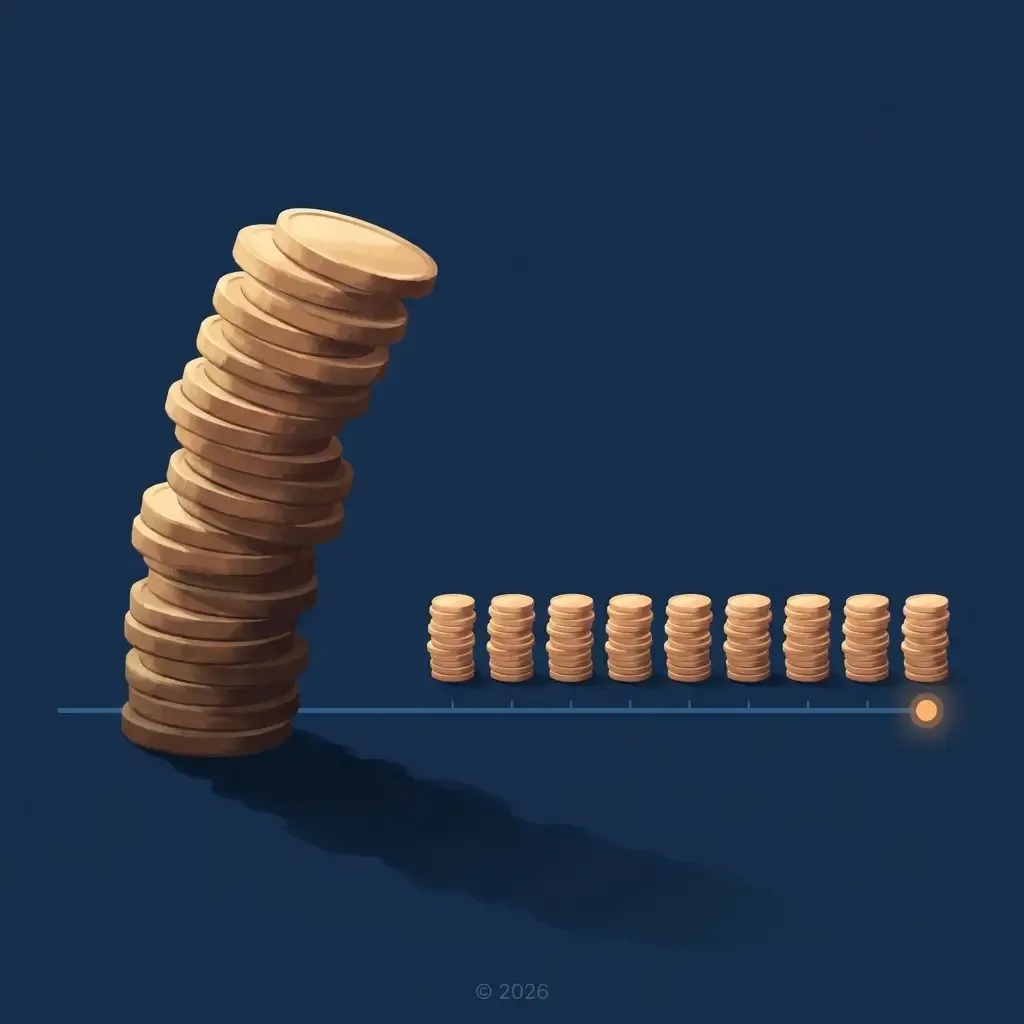
Here’s the math almost nobody runs before they default to waiting. Say you inherit a $500,000 traditional IRA. Left alone, it might grow to $700,000 or more over ten years. If you pull the whole thing out in year ten, that entire amount lands on one tax return, on top of your regular income.
A withdrawal that large doesn’t just get taxed at your normal rate. It pushes you up through the brackets. For tax year 2026, the IRS sets the top 37% federal bracket at income above $768,700 for married couples filing jointly, but you don’t need to be anywhere near that to feel the damage. A six-figure distribution dropped onto a normal salary can jump you two or three brackets in a single year.
Then there’s the part almost nobody sees coming: Medicare. Your IRA withdrawals count toward the income figure that determines your Medicare premiums. The income-related monthly adjustment amount, or IRMAA, starts above $109,000 for single filers and $218,000 for married couples filing jointly in 2026, per CMS. Cross those lines and your Medicare Part B premium climbs above the standard $202.90 a month, sometimes by hundreds of dollars per person. A single oversized withdrawal in your sixties can quietly raise your healthcare costs two years later, because Medicare looks back at your income from two years prior.
Can an inherited IRA withdrawal raise my Medicare premiums?
Yes. The withdrawal counts toward the income that sets IRMAA. Per CMS, 2026 surcharges begin above $109,000 single or $218,000 joint, lifting Part B above the $202.90 base. Because Medicare uses a two-year lookback, an oversized distribution in your sixties can raise premiums two years later.
There’s also a state-level layer most people forget. If you live somewhere with a state income tax and you might move to a lower-tax or no-tax state later, draining the account in one shot locks in your current state’s rate on the whole balance. Spreading withdrawals gives you the option to take some of those dollars out after a move, when the state bite could be smaller. That’s not a reason to relocate, but it’s a variable worth putting on the table when the balance is large.
How do you spread inherited IRA withdrawals the right way?
The fix is to treat the 10-year window as a tax-planning runway, not a countdown you ignore until the last second. Here’s the approach that works for most people:
- Find the top of your current bracket. Look at your taxable income this year and figure out how much room you have before you’d jump into the next bracket. That gap is your annual withdrawal target.
- Withdraw up to that line each year. Take distributions that fill your current bracket but don’t spill into the next one. You’re paying tax either way; the goal is to pay it at a lower rate spread across years instead of one brutal rate in year ten.
- Watch the IRMAA thresholds, not just the tax brackets. If you’re on Medicare or within two years of it, size your withdrawals to stay under the $109,000 single or $218,000 joint income lines where surcharges kick in. Sometimes the Medicare line matters more than the bracket.
- Front-load during low-income years. If you retire, take a sabbatical, or have a gap year before Social Security and your own RMDs begin, that’s prime withdrawal territory. Pull more in those years when your other income is low, and ease off in years when a bonus, a big capital gain, or a vesting event already has your bracket crowded. The window is ten years long for a reason; lean on the low years and leave the high ones alone.
- Recheck every year. Your income changes. Tax law changes. A plan you set in year one should get a fresh look each year, because the right number this year is rarely the right number next year.
None of this requires exotic strategy. It requires running the numbers before the deadline runs them for you.
When does waiting actually make sense?
I’m not going to pretend the spread-it-out approach is universal. There are real cases where delaying is the better call.
If you expect your income to drop sharply, say you’re two years from retiring and your bracket is about to fall off a cliff, holding off until those lower-income years can beat withdrawing now. If the inherited balance is small enough that even a lump sum wouldn’t move your bracket, the timing barely matters and you can keep it simple. And if you have room in a year where a Roth conversion or other planning move is already eating your bracket space, you’d coordinate around that.
The point isn’t “always withdraw early.” The point is that “wait until year ten” should be a decision you make on purpose after looking at the math, not a default you back into because touching the account felt premature.
Frequently Asked Questions
What is the inherited IRA 10-year rule?
Per the IRS, most non-spouse beneficiaries must fully empty an inherited IRA by December 31 of the tenth year after the original owner’s death. The SECURE Act removed the old lifetime stretch. If the owner had already begun RMDs, the heir must also take annual distributions during the window.
Why is draining an inherited IRA in year ten a mistake?
Because it stacks a decade of withdrawals onto one tax return. A $500,000 IRA that grows to $700,000 dumped in year ten can jump you several brackets at once, toward the 37% top rate, and spike that year’s income far above what spreading it out would.
How should you withdraw from an inherited IRA?
Treat the 10 years as a planning runway. Each year, take distributions that fill your current bracket without spilling into the next, watch the IRMAA thresholds, and front-load in low-income years. Recheck annually as income and tax law change. The goal is paying tax at lower rates across years.
Is it ever better to wait before withdrawing from an inherited IRA?
Yes, in specific cases. If your income is about to drop sharply, such as retiring within a year or two, delaying into those lower-bracket years can win. If the balance is small enough that a lump sum won’t move your bracket, timing barely matters. Choose it on purpose, not by default.
What is the real decision point?
Pull up the inherited account and ask one question: what does my tax bill look like if I empty this in the final year versus spreading it across the time I have left? Most people skip that comparison entirely, and for a large inherited balance the difference can be tens of thousands of dollars. The inherited IRA 10-year rule rewards people who plan the whole decade and quietly penalizes the ones who wait. If you inherited an IRA in the last couple of years, the clock is already ticking, and the right year to start planning was the year you inherited it. The next best window is this one. If you want a second set of eyes on the math before you decide, that’s a conversation worth having now, not in year nine.
Schedule a no-obligation call with Jeff to map the ten-year distribution schedule against your own tax picture.
The information provided is for educational purposes only and should not be construed as investment advice. Investment strategies should be tailored to individual circumstances, risk tolerance, and goals. Past performance doesn’t guarantee future results. Consult with qualified financial professionals regarding your specific situation. Securities offered through LPL Financial, Member FINRA/SIPC. Investment advice offered through Great Valley Advisor Group, a registered investment advisor and separate entity from LPL Financial. © 2026 JeffJudgeCFP.com | Not to be reproduced in whole or in part. All rights reserved.