



Last reviewed: July 2026
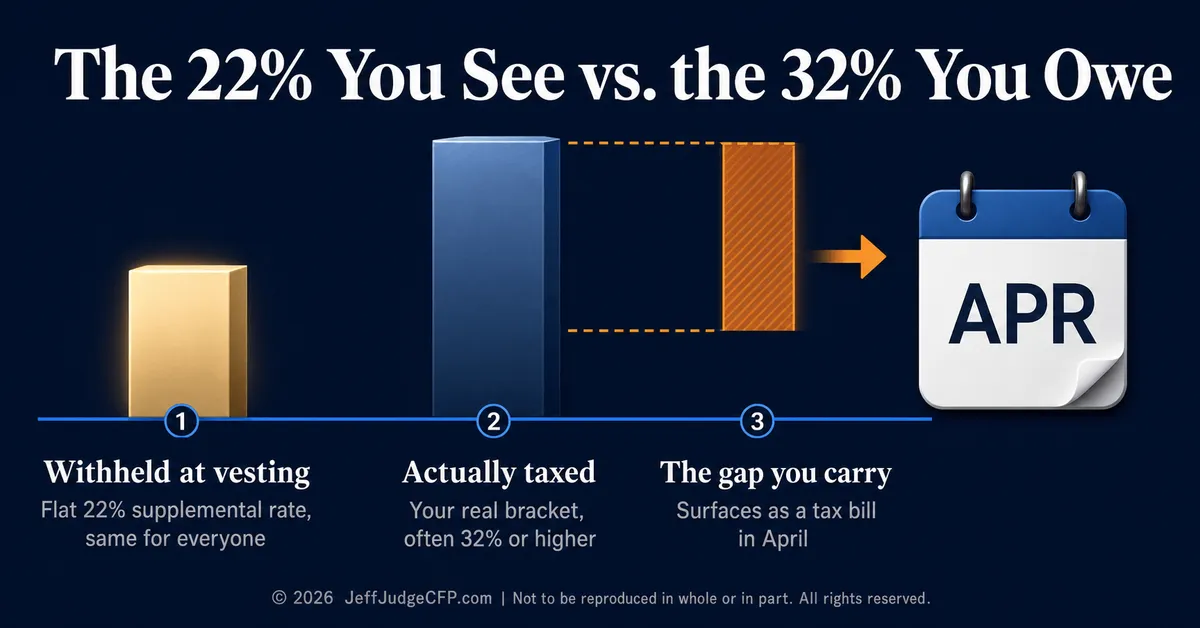
Your company almost certainly withheld too little tax when your RSUs vested. For most equity employees, RSU tax withholding happens at the flat 22% supplemental rate the IRS sets for bonuses and stock compensation, while your actual marginal bracket is 32% or higher. That gap is not a mistake. It is the default, and it quietly builds an April tax bill that nobody warned you about.
Here is the part that catches people: the vesting event already felt like it was handled. Shares hit your account, some were sold to cover taxes, the rest landed in your brokerage. It looks complete. The shortfall does not show up until you file, and by then every lever that could have closed the gap is already behind you.
Key Takeaways
- Per the IRS, RSUs are withheld at the flat 22% supplemental rate, but many equity employees are in the 32% bracket or higher.
- On a $200,000 vest, 22% withholds $44,000 while a 32% rate owes $64,000, a $20,000 gap you’re carrying unaware.
- Per the IRS 2026 schedule, the 32% bracket starts at $201,775 single and $403,550 joint; 37% above $640,600 single.
- Sell-to-cover only funds the 22% withholding, not your true rate, so the shortfall surfaces only at filing.
- Close it before December 31 with extra W-4 withholding or a quarterly estimated payment, which can also dodge an underpayment penalty.
About the Author
About the Author: Jeff Judge, CFP®, AEP®, ChFC®, CLU® is a financial planner who writes Viewpoints for JeffJudgeCFP.com. He helps families and business owners close the RSU withholding gap before year-end and trim concentrated stock on a tax-aware schedule, using the R.U.D.D.E.R. Method™, the financial planning process Jeff developed. “Vesting isn’t the finish line. It’s the moment a countdown starts, and you have until year-end to close the gap on your terms instead of the IRS’s.”
How does RSU tax withholding actually work?
When RSUs vest, the value of the shares becomes ordinary income, taxed like salary. Your employer has to withhold something, so it withholds at the IRS supplemental wage rate. According to the IRS, the optional flat rate for supplemental wages is 22% as long as your total supplemental wages for the year stay at or under $1,000,000. Above that $1,000,000 threshold, the IRS requires a mandatory 37% rate on the excess.
So the machinery is doing exactly what it was built to do. The problem is that 22% is a single national rate applied to everyone under the threshold, and it has no idea what bracket you are actually in.
If you earn enough that RSUs are a meaningful part of your pay, you are probably not in the 22% bracket. Per the IRS 2026 rate schedule, the 32% bracket starts at $201,775 for single filers and $403,550 for married couples filing jointly, and the top 37% rate applies once a single filer’s income passes $640,600. When your real marginal rate is 32% and the withholding came out at 22%, every vested dollar is short by roughly ten cents. On a $200,000 vest, that is around $20,000 you still owe and have not set aside.
Walk through it with round numbers. Say $200,000 of RSUs vest in a year when your salary already puts you in the 32% bracket. Your employer withholds 22%, or $44,000, and your sell-to-cover sells just enough shares to fund that. But the income is actually taxed at 32%, which is $64,000. The $20,000 difference does not bounce, does not generate a warning, and does not appear anywhere until your return is filed. It simply sits as a liability you are carrying without knowing it.
Why does the flat 22% rate under-withhold high earners?
Because 22% is a single supplemental rate the IRS applies to everyone below $1,000,000 in supplemental wages, with no regard for your actual bracket. If your marginal rate is 32%, every vested dollar is short about ten cents. On a $200,000 vest, that is roughly $20,000 still owed and not set aside.
What Question Should You Be Asking at Vesting?
The instinct is to ask “did they take out taxes?” The better question is “did they take out enough?” Those are different questions, and only the second one keeps you out of trouble.
Does selling shares to cover taxes mean I’m covered?
Not necessarily. The “sell to cover” most plans run automatically sells just enough shares to satisfy the 22% withholding, not your true rate. It covers the withholding obligation, not your actual liability. If your bracket is higher, you are still short by the difference.
Why does this only show up in April?
Because withholding is an estimate paid throughout the year, and your real tax is calculated once, when you file. The 22% versus 32% gap is invisible until the return reconciles what was withheld against what was owed. That timing is the entire trap.
How big can the gap get?
It scales with the size of the vest and the distance between 22% and your bracket. A 10-point gap on $150,000 of vesting is roughly $15,000. A larger vesting year, or income that pushes you toward the 35% or 37% brackets, widens it further. And it stacks across multiple vesting events in the same year, so someone with quarterly vests can carry the same shortfall four times over before they ever file.
Does this apply to ISOs and NQSOs too?
The supplemental withholding mechanics are most direct with RSUs and NQSOs. Incentive stock options follow different rules and can trigger alternative minimum tax instead, which is its own separate surprise. The common thread is the same: equity income rarely gets withheld at your real rate.
What move do most high earners miss?
Here is what actually closes the gap. You have two levers, and both have to be pulled before December 31, not in April.
The first is adjusting withholding elsewhere. You can have extra tax withheld from your regular paycheck using a revised Form W-4, which spreads the catch-up across the rest of the year instead of leaving a lump owed at filing. The second is making a quarterly estimated tax payment to the IRS in the quarter your shares vested. Either one can keep you current. Doing nothing is the one choice that leaves the entire bill to land at once, in April, when you have no moves left.
Which lever is better depends on your situation. If your vest happened early in the year, bumping up paycheck withholding gives you more months to absorb it. If it landed in the fourth quarter, an estimated payment for that quarter is usually the cleaner fix. Neither one is complicated. They just have to happen before the year closes, which is the part people skip because the vesting already felt finished.
There is a second-order benefit here too. The IRS can charge an underpayment penalty when you owe too much at filing and did not pay in enough during the year. Closing the withholding gap on time does more than smooth out the cash flow. It can also help you sidestep that penalty, which is pure waste, money paid for nothing more than bad timing.
Should you adjust your W-4 or make an estimated payment after a vest?
Either works, and the timing decides which. If the vest landed early in the year, raising paycheck withholding on a revised W-4 spreads the catch-up across more months. If it hit in the fourth quarter, a quarterly estimated payment is usually cleaner. The one losing move is doing nothing until April.
The reason most people miss this is not laziness. It is that the vesting event looks finished. Shares moved, taxes appeared to be handled, and the brain files it under “done.” The work that matters happens after the confetti, in the unglamorous step of checking whether the withholding actually matched your bracket.
Frequently Asked Questions
Why are RSUs under-withheld at tax time?
Per the IRS, employers withhold RSU income at the flat 22% supplemental rate for supplemental wages up to $1,000,000. Many equity employees are actually in the 32% bracket or higher, so the 22% default leaves a gap that surfaces as a balance due when you file.
How much could I owe on my RSUs in April?
It is the spread between 22% and your real rate, times the vest. On a $200,000 vest taxed at 32%, withholding of $44,000 falls $20,000 short of the $64,000 owed. Multiple vests in one year stack that shortfall, so a quarterly schedule can carry it several times over.
How do you avoid an RSU tax surprise?
Act before December 31. Either raise withholding on a revised Form W-4 or make a quarterly estimated payment for the quarter your shares vested. Both keep you current and can help you avoid an IRS underpayment penalty. Waiting until you file removes every lever.
Should you sell RSUs after they vest?
Often, yes, on a disciplined schedule. Letting vested shares pile up to defer a taxable event stacks concentration risk on top of the withholding gap. A plan that closes the tax gap usually pairs with a tax-aware way to trim a position that has grown into a large bet on one employer.
What does this mean if you hold concentrated stock?
One more issue compounds quietly underneath this. If you let vested shares pile up because selling feels like a tax event you would rather defer, you are stacking two separate risks: an under-withheld tax bill and a portfolio that is increasingly tied to one company’s stock price. The tax gap is an annual problem. The concentration is a slower one, and it tends to get worse precisely because the tax friction makes selling feel unappealing. People talk themselves into holding because “I do not want another taxable event this year,” and a few years later half their net worth is riding on a single employer they cannot control. The reluctance feels prudent in the moment. It is usually just deferral dressed up as discipline.
You do not have to solve both in the same week. But they are connected, and a plan that addresses the withholding gap is usually the same plan that gives you a disciplined, tax-aware way to trim the concentration over time. The two problems share a root: equity compensation that was issued on the company’s schedule and taxed on the IRS’s schedule, but mapped against your actual financial picture by no one.
That is the quiet cost of equity comp. Not that it is taxed, but that the withholding, the brackets, and the concentration each get handled in isolation, by systems that do not talk to each other. A 22% withholding rate, a 32% bracket, and a position that keeps growing in one stock are three facts that only become a problem when you finally look at them together.
The takeaway is simple. Vesting is not the finish line. It is the moment the clock starts on a decision you have until December to make. If you have RSUs vesting this year, pull your latest pay stub, find the RSU tax withholding rate on the equity income, and compare it to the bracket you are actually in. If there is a gap, you have a few months to close it on your terms instead of the IRS reconciling it on theirs in April. The employees who get blindsided are not the ones who did something wrong. They are the ones who assumed a system designed for the average case had accounted for their specific situation. It rarely does. If you want a second set of eyes on the numbers before year-end, that is exactly the kind of thing worth a conversation while the levers are still in reach.
Schedule a no-obligation call with Jeff to check whether your RSU withholding is covering your actual tax bill.
The information provided is for educational purposes only and should not be construed as investment advice. Investment strategies should be tailored to individual circumstances, risk tolerance, and goals. Past performance doesn’t guarantee future results. Consult with qualified financial professionals regarding your specific situation. Securities offered through LPL Financial, Member FINRA/SIPC. Investment advice offered through Great Valley Advisor Group, a registered investment advisor and separate entity from LPL Financial. © 2026 JeffJudgeCFP.com | Not to be reproduced in whole or in part. All rights reserved.