



Last reviewed: July 2026
Delaying Social Security to age 70 raises your monthly benefit by 24% compared to claiming at your full retirement age, per the Social Security Administration. That’s real money. But the math most people skip runs in the other direction: every month you delay is a month of benefits you don’t collect. The question isn’t whether delay pays off in theory. It’s whether it pays off for you, in your actual lifetime, with your actual health and income picture.
Key Takeaways
- Per the SSA, delaying Social Security to age 70 raises your monthly benefit by 24% over your full retirement age amount.
- Delay only pays off if you outlive the breakeven age, which is roughly 80 to 83 for most claiming comparisons.
- Waiting one year forgoes about $24,850 at the 2026 average benefit of $2,071 a month; 62-to-70 forgoes roughly $134,000.
- SSA tables put life expectancy near 82 for a man and 85 for a woman reaching 62; half the population falls short.
- A higher benefit can raise taxes and Medicare IRMAA surcharges, so model the tax effects before you decide.
About the Author
About the Author: Jeff Judge, CFP®, AEP®, ChFC®, CLU® is a financial planner who writes Viewpoints for JeffJudgeCFP.com. He helps families and business owners run the honest Social Security breakeven, including the scenario where claiming early wins, using the R.U.D.D.E.R. Method™, the financial planning process Jeff developed. “Always delay to 70 isn’t planning. It’s a rule of thumb dressed up as advice. Run the math with your own numbers.”
What do the SSA’s numbers actually say?
Per the Social Security Administration, someone born in 1960 or later who waits until 70 receives 124% of their full retirement age (FRA) benefit. Filing at 62 reduces it to roughly 70%. The spread is real. If your FRA benefit is $2,000 per month, claiming at 70 gets you $2,480. Claiming at 62 gets you about $1,400. That’s a $1,080 monthly gap.
What gets less attention is the breakeven math. Every claiming strategy has a crossover point where cumulative lifetime benefits from waiting finally exceed cumulative lifetime benefits from claiming earlier. Here’s what that looks like with a $2,000 FRA benefit as the example:
| Claim Age | Delay To | Monthly Difference | Foregone Before Delay Ends | Break-Even Age (approx.) |
|---|---|---|---|---|
| 62 | 67 | +$600/mo | $84,000 | ~79 |
| 62 | 70 | +$1,080/mo | $134,400 | ~80 |
| 67 | 70 | +$480/mo | $72,000 | ~82-83 |
Illustrative example using a $2,000/month FRA benefit. Your actual benefit amounts will differ.
The per the Social Security Administration average monthly retirement benefit in 2026 is $2,071 — close enough to run this math with real numbers. The breakeven for the 67-to-70 delay is around age 82 to 83 for most people. For a woman reaching 62 today, SSA actuarial tables put average life expectancy at about 85. For a man, it’s about 82. Those are averages. Half the population falls short of them.
Why does average life expectancy matter so much for this decision?
Because the delay-to-70 case rests on collecting the higher benefit for many years. If breakeven lands in your low 80s but your realistic life expectancy sits right around there, the gain is thin. Your personal and family health history, not the population average, should drive the estimate you use.
What Social Security timing questions do people actually ask?
When does delaying Social Security pay off?
Delay pays off when you live past the breakeven age. For most people comparing claiming at 67 versus 70, that breakeven falls between age 82 and 83. If you’re in good health with strong longevity indicators, the math often favors waiting. If your health history or family history cuts the other direction, the case for delay weakens considerably.
What does delaying Social Security actually cost in the short term?
Every year of delay is a year of benefits not collected. At the SSA’s 2026 average monthly benefit of $2,071, one year of delay costs roughly $24,850 in foregone income. Delaying from 62 to 70 means foregoing about $134,000 before the higher check starts. If that money could have been invested at even a modest rate, the opportunity cost compounds during the same period.
Does your spouse’s situation change the calculation?
Yes, significantly. If you’re the higher earner in a married couple, your benefit at death becomes the survivor benefit your spouse receives. A higher monthly check today translates directly to better income security for a surviving spouse later. This consideration alone shifts the math toward delay for many high-earning spouses in good health.
What’s the problem with the “you’ll live to 90” argument?
Most arguments for delaying Social Security anchor on longevity. The logic sounds airtight: Social Security is longevity insurance, and if you live to 95, the higher benefit pays off dramatically. That’s a real consideration. It’s not the complete calculation.
SSA actuarial tables indicate a man reaching 62 in the U.S. averages about 82 years of life expectancy. A woman reaching 62 averages about 85. Half the population lives shorter than those numbers. If your current health, family history, or medical situation puts you below average, the “delay to maximize” argument gets weaker with each realistic scenario you run.
There’s also the tax angle most people miss. A higher Social Security benefit raises your income floor. Under IRS combined income thresholds, up to 85% of Social Security benefits become taxable once combined income (adjusted gross income plus half of Social Security) exceeds $44,000 for married filers. A larger monthly check may push more of your Social Security into taxable territory than a smaller one would. And two years after income is reported, Medicare’s IRMAA surcharges kick in based on that income, affecting Part B and Part D costs.
| Factor | Points Toward Earlier Claiming | Points Toward Delay to 70 |
|---|---|---|
| Health | Poor health or shortened family longevity | Good health and family history into mid-80s |
| Marital status | Single, no survivor benefit concern | Married, lower-earning or younger spouse |
| Other income | Need Social Security to cover expenses | Can bridge expenses without claiming |
| Tax situation | Low income floor, SS mostly tax-free | Higher bracket; IRMAA already modeled |
When does delaying Social Security make sense?
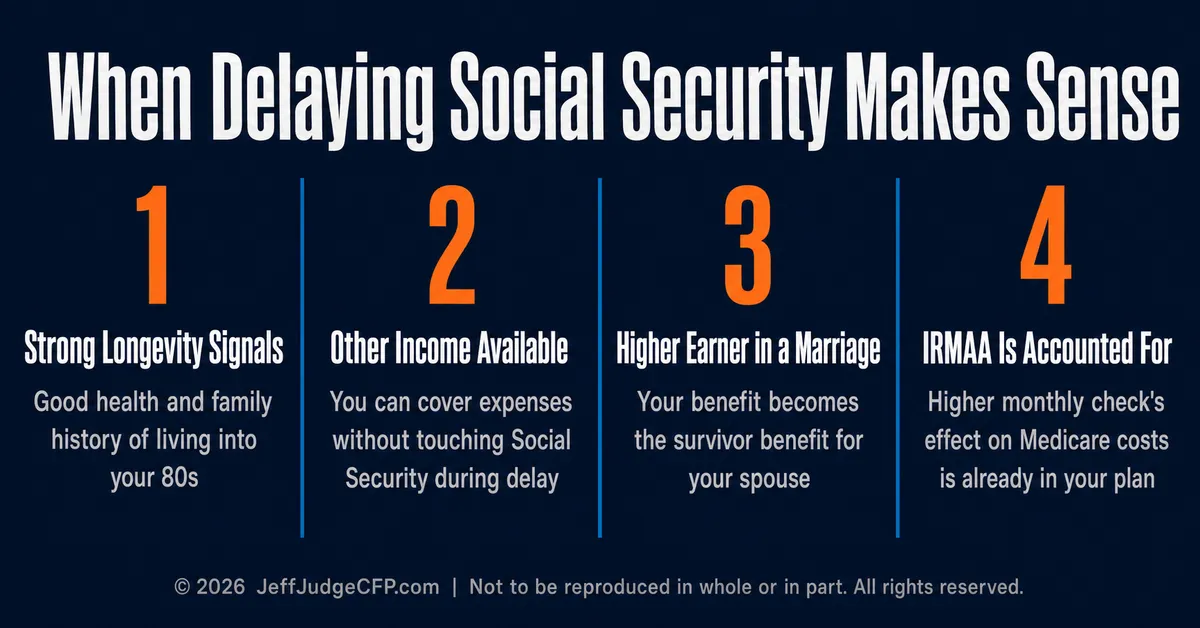
Delay is generally the right call when you’re in good health with strong longevity indicators, when you can cover living expenses from other income sources during the delay years, when you’re the higher earner in a married couple (your benefit becomes the survivor benefit), and when the tax implications have been modeled and accounted for.
The IRMAA point trips people up consistently. Medicare Part B and Part D premiums are based on income from two years prior. A larger Social Security check starting at 70 raises your income floor in retirement, which can trigger surcharges that offset part of the monthly benefit gain. This isn’t a reason to avoid delay — it’s a reason to model it rather than assume it away.
Does delaying always increase your income after taxes and Medicare?
Not always. A larger Social Security check can push more of your benefit into taxable income and, two years later, raise Medicare Part B and Part D premiums through IRMAA. Those costs can offset part of the delay benefit, which is exactly why the tax and IRMAA effects belong in the model.
Frequently Asked Questions
How much does Social Security increase if you wait until 70?
Per the Social Security Administration, waiting until age 70 raises your benefit to 124% of your full retirement age amount, a 24% increase over claiming at full retirement age. Claiming at 62 instead reduces it to roughly 70% of your full retirement age benefit.
What is the breakeven age for delaying Social Security?
The breakeven age is when the larger delayed checks finally surpass the benefits you skipped while waiting. For a typical comparison of claiming at 67 versus 70, breakeven lands around age 82 to 83. Live past it and delay wins; fall short and earlier claiming wins.
How does delaying Social Security affect taxes and Medicare?
A higher benefit raises your income, so more of your Social Security can become taxable; up to 85% is taxable once combined income passes $44,000 for married filers. Two years later, that income can also trigger Medicare IRMAA surcharges on Part B and Part D premiums.
Where can I find my own Social Security benefit estimates?
Pull your projected benefit at each claiming age directly from your account at SSA.gov. Then run a breakeven using your actual numbers, realistic health and longevity, and your other income sources. The honest calculation takes about 20 minutes and should include the scenario where claiming early is better.
What does the right answer actually require?
There is no blanket answer on Social Security timing, and you should be suspicious of anyone who offers one. “Always delay to 70” is not financial planning. It’s a rule of thumb dressed up as advice.
The right answer requires four inputs: your projected benefit at each claiming age (pull this from SSA.gov directly), your realistic health and longevity picture, your other income sources and how they interact with Social Security year by year, and a breakeven calculation run with your actual numbers.
That calculation isn’t complicated. It takes about 20 minutes with a spreadsheet or a planning tool. What it requires is someone willing to run the honest version, including the scenario where claiming early turns out to be the better call.
The math nobody does is the one that might tell you waiting cost you money. Run it before you decide.
Schedule a no-obligation call with Jeff to run the breakeven numbers for your specific situation.
The information provided is for educational purposes only and should not be construed as investment advice. Investment strategies should be tailored to individual circumstances, risk tolerance, and goals. Past performance doesn’t guarantee future results. Consult with qualified financial professionals regarding your specific situation. Securities offered through LPL Financial, Member FINRA/SIPC. Investment advice offered through Great Valley Advisor Group, a registered investment advisor and separate entity from LPL Financial. © 2026 JeffJudgeCFP.com | Not to be reproduced in whole or in part. All rights reserved.