



Last reviewed: October 2026
Concentrated stock risk is the variable most tech employees ignore, because their company stock has only ever gone up. Here is the part that gets missed: when most of your net worth sits in your employer’s shares, your job and your savings are the same wager. One bad quarter can hit your bonus, your unvested equity, and your liquid wealth at the same time. That is not diversification with an upside. It is a single position that happens to also sign your paychecks.
I see this constantly with people who are good at their jobs and sharp with numbers. They will model an options trade six ways, then hold sixty percent of their net worth in one ticker and call it investing. It isn’t. It is correlation they never priced in.
Key Takeaways
- When most of your net worth is in your employer’s stock, your job and your savings are the same bet.
- A common rule of thumb: any single stock above 10 to 15% of investable assets deserves a hard look.
- Per the SEC, concentrating in one security raises the risk of large losses because everything rides on one company.
- Per the IRS, 2026 long-term gains are taxed at 15% up to $545,500 single and 20% above, the lever for timing sales.
- Selling on a schedule spreads the risk without forcing one giant taxable event or one leap of faith.
About the Author
About the Author: Jeff Judge, CFP®, AEP®, ChFC®, CLU® is a financial planner who writes Viewpoints for JeffJudgeCFP.com. He helps families and business owners measure single-stock exposure and trim it on a tax-aware schedule before the next vest, using the R.U.D.D.E.R. Method™, the financial planning process Jeff developed. “Holding too much of your own company isn’t conviction, it’s correlation you never priced in. The fix isn’t dramatic: measure the number, then trim on a schedule before the next vest makes the choice for you.”
What Is Concentrated Stock Risk, Really?
Concentrated stock risk is the exposure you carry when a large share of your wealth depends on the performance of a single company. For an index fund holder, a bad year at one firm barely registers. For someone holding a pile of employer RSUs, that same bad year can erase a number with five or six zeros in it.
The reason this matters more for tech and equity-comp employees than almost anyone else comes down to a word people skip: correlation. Your salary, your next vesting tranche, and your brokerage balance are all tied to the same company. They tend to move together. When the stock drops on a weak earnings call, the layoff risk and the equity hit and the paper loss in your account can all arrive in the same week. The thing that pays your mortgage and the thing that funds your retirement are the same bet, and you only notice once it goes against you.
How much concentration is too much?
A common planning rule of thumb is that any single stock making up more than ten to fifteen percent of your investable assets deserves a hard look. Plenty of equity-comp employees are sitting at forty, fifty, sixty percent and have never run the number. The first move is not to sell. It is to actually calculate the percentage, because most people are carrying more than they think.
Doesn’t holding the winner beat diversifying?
Sometimes, in hindsight, sure. The problem is you are making a forward decision with backward data. The SEC has repeatedly warned investors that concentrating holdings in a single security raises the risk of large losses, because the fate of your money rides on one company instead of many. Holding the winner feels obvious right up until the quarter it stops winning.
What actually lowers the exposure?
Selling some, on a schedule, before you have an opinion about the price. A written plan that says “I trim this percentage each quarter regardless of how I feel” takes the emotion out. Spreading the proceeds across a broader set of holdings spreads the risk across more companies. None of this removes uncertainty. It just stops one company from holding the whole outcome.
Why do smart people hold too much of one stock?
The behavior is not about math. It is about story. You watched the stock climb. You know the company from the inside. You feel like you understand it better than the market does, so selling feels like betting against your own team.
That instinct is human, and it is expensive. Familiarity is not the same thing as safety. Knowing where the bodies are buried at your own company tells you nothing about what the broader market will pay for the stock next year, and it tells you nothing about the macro shock that hits your whole sector at once. Some of the most painful single-stock losses in the last twenty-five years happened to employees who were certain their company was different, right up until it wasn’t.
There is also the tax flinch. Nobody wants to write a check to the IRS, so the shares sit. But “I don’t want to pay the tax” is not a strategy. It is a way of letting the IRS decide your asset allocation for you. And the catch most people find out too late: the loss on an undiversified position that drops can dwarf the tax you were trying to avoid. You can always plan around a tax bill. You cannot plan around a position that fell sixty percent while you were waiting to feel ready.
Is avoiding the tax a good reason to keep the stock?
No. ‘I don’t want to pay the tax’ lets the IRS set your asset allocation. The tax on trimming is knowable and plannable; the loss on a concentrated position that drops can dwarf it. Deferring the bill often just enlarges the bet you were already overexposed to.
The other quiet driver is inertia dressed up as conviction. “I’ll deal with it after the next vest” turns into three years of vests, and now the position is even bigger and the decision feels even heavier. The longer you wait, the more the choice makes itself, and not in your favor.
What does concentrated stock cost you at tax time?
Here is where it gets concrete, and where the planning actually pays off. When you sell appreciated shares you have held more than a year, the gain is taxed at long-term capital gains rates. According to the IRS, in 2026 the 15 percent long-term capital gains rate applies to single filers with taxable income up to $545,500, and the 20 percent rate kicks in above that. That spread is the lever. Selling in a lower-income year, or spreading sales across several years, can keep more of the gain in the 15 percent band instead of the 20 percent one.
Compare that to the alternative most people default into. Your employer withholds a flat 22 percent on RSU income at vesting, which is often below the bracket a high earner actually lands in. So the shares vest, you mentally file them as “handled,” and you are now carrying a concentrated position and an under-withholding problem at the same time. The first you notice in a down quarter; the second you notice in April.
There is a quieter cost too. Every dollar locked in one company is a dollar not funding the accounts built for retirement. The IRS set the 401(k) employee contribution limit at $24,500 for 2026. Plenty of equity-comp employees leave part of that on the table because their cash and attention are tied up in the same stock they already own too much of. The opportunity you give up there does not show up on any statement, which is exactly why it gets ignored.
How can you trim concentrated stock without a tax shock?
Sell on a schedule rather than all at once. Per the IRS, 2026 long-term gains sit at 15% up to $545,500 of taxable income for single filers and 20% above, so spreading sales across years can keep more of the gain in the lower band instead of stacking it into one return.
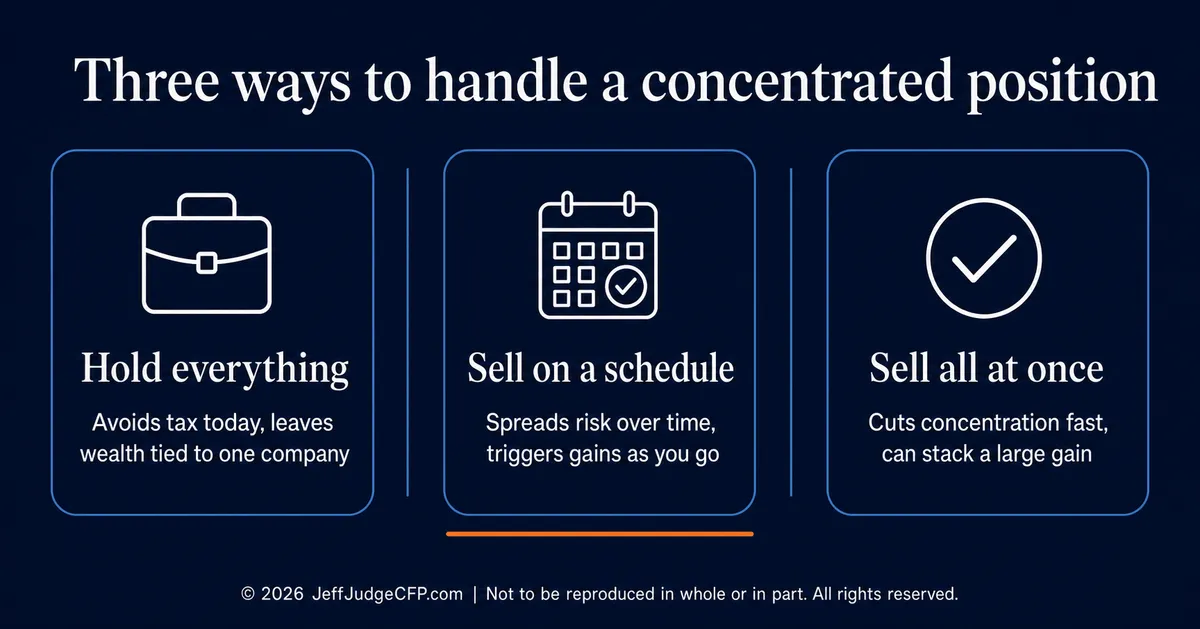
| Approach | What it manages | What it doesn’t |
|---|---|---|
| :— | :— | :— |
| Hold everything | Avoids a tax bill today | Leaves your wealth tied to one company |
| Sell on a schedule | Spreads risk across more holdings over time | Triggers capital gains as you go |
| Sell all at once | Cuts concentration fast | Can stack a large gain into one tax year |
A schedule is usually the middle path that fits real life. It is not the cheapest on taxes and it is not the fastest at cutting risk, but it keeps you moving without forcing one giant taxable event or one giant leap of faith.
Frequently Asked Questions
What is concentrated stock risk?
It’s the exposure of having a large share of your wealth ride on one company. For equity-comp employees, salary, future vesting, and brokerage balance are all tied to the same stock, so they move together. A weak quarter can hit your job and your savings in the same week.
How much company stock is too much?
A common planning rule of thumb flags any single stock above 10 to 15% of your investable assets for a hard look. Many equity-comp employees sit at 40, 50, or 60% without ever running the number. The first step is calculating the percentage, not selling.
How are gains on company stock taxed in 2026?
Shares held more than a year get long-term capital gains rates. Per the IRS, in 2026 the 15% rate applies to single filers with taxable income up to $545,500, and 20% applies above that. Selling in lower-income years or spreading sales can keep more gain in the 15% band.
What is the best way to reduce a concentrated position?
Usually a schedule. Selling a set percentage each quarter, decided in advance, spreads risk across more holdings without one giant taxable event or one leap of faith. It is neither the cheapest on taxes nor the fastest at cutting risk, but it keeps you moving and removes the emotion.
What is the one number to run this week?
Pull up every account you have and calculate what percentage of your investable net worth sits in your employer’s stock. Just that one figure. If it is north of ten to fifteen percent, you are not investing in your company anymore. You are carrying concentrated stock risk whether you admit it or not, and you did not decide to take it on with your eyes open. The fix is not dramatic. It starts with a plan to trim, a tax-aware schedule, and a clear-eyed look at the number you have been avoiding. If you want a second set of eyes on what that schedule should look like for your situation, that is a conversation worth having before the next vest, not after.
Schedule a no-obligation call with Jeff to size the concentration risk in your company shares and build a plan to reduce it.
The information provided is for educational purposes only and should not be construed as investment advice. Investment strategies should be tailored to individual circumstances, risk tolerance, and goals. Past performance doesn’t guarantee future results. Consult with qualified financial professionals regarding your specific situation.
Securities offered through LPL Financial, Member FINRA/SIPC. Investment advice offered through Great Valley Advisor Group, a registered investment advisor and separate entity from LPL Financial.
© 2026 JeffJudgeCFP.com | Not to be reproduced in whole or in part. All rights reserved.