



Everyone in personal finance is optimizing their asset allocation. Checking the stock-to-bond ratio. Rebalancing toward the target. Debating whether to tilt toward small-cap value or factor-weight the international exposure. Meanwhile, most of these same people have never done a systematic audit of the fees running through their financial picture.
That’s the optimization problem worth solving first. And it’s not close.
What does portfolio over-optimization actually cost?
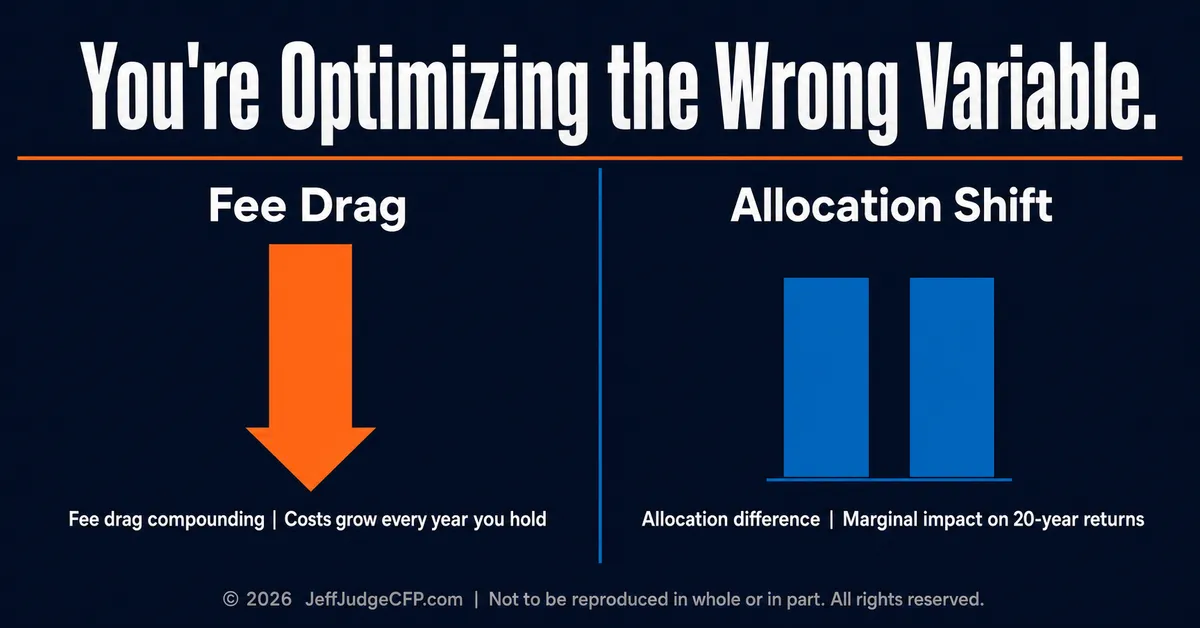
The return gap from fees: Per FINRA investor education data, the difference between a 0.10% expense ratio index fund and a 1.0% actively managed fund, held for 20 years on a $300,000 account, can exceed $100,000 in compounded difference. That’s not a return difference from asset allocation. It’s a tax from an administrative choice.
The return gap from behavior: Per the SEC, actively managed funds underperform their benchmark indices after fees in the majority of 10 and 20-year measurement periods. The investor in those funds also underperforms the fund itself due to poorly timed entry and exit decisions. The alpha investors are chasing through allocation optimization is generally negative after all costs are counted.
The allocation variance that actually matters: Research on long-term portfolio outcomes consistently shows that asset allocation accounts for a large majority of return variance. But the allocation differences most investors debate, should I be 60/40 or 65/35, should I tilt toward international developed or not, have far smaller practical effects than the fee differential and the behavioral gap between fund return and investor return.
Why people optimize allocation instead of fees
Allocation feels like investing. It involves analysis, research, and decisions that feel like expertise. Fees feel like an administrative matter that someone else should handle. This is exactly backwards from where the leverage is.
Allocation optimization is also easier to talk about and more emotionally satisfying. You’re “managing” something. Fee optimization involves admitting you’ve been overpaying, having a conversation with an advisor about expenses, or moving accounts, all of which feel harder than adjusting a stock-bond ratio.
The fee audit most people have never done
Start with investment expense ratios. Pull the expense ratio on every fund you own across every account. The IRS allows a deduction for investment advisory fees in some contexts, but the more important number is what you’re paying in fund expenses before any tax consideration. Anything above 0.50% per year deserves a scrutiny question: what am I getting for this that a 0.05% index fund in the same asset class doesn’t provide?
Account-level advisory fees next. If you pay an AUM-based fee, calculate what you’re paying in dollars per year. A 1% fee on a $600,000 portfolio is $6,000 per year. That’s the floor of what the advisor relationship needs to justify, in tax savings, behavioral coaching, planning services, or risk management. If you can’t articulate $6,000 worth of annual value, the fee deserves a conversation.
Insurance product fees often go unexamined longest. Variable annuities, permanent life insurance with cash value components, and indexed products carry mortality and expense charges, administrative fees, and rider charges that don’t appear on investment statements. Per the SEC, the total annual cost of a variable annuity can run 2 to 3% annually when all layers are counted. That’s compounding against you on assets that may already be in a tax-advantaged account.
What the right sequence of financial priorities actually looks like
Before you debate 60/40 vs. 70/30, audit the fees. Before you consider adding international small-cap exposure, calculate what you’re currently paying across all accounts. Before you hire someone to optimize your allocation, make sure you understand the total cost of ownership of your existing financial products.
The Contrarian Take here is that most people who describe themselves as actively managing their portfolio are optimizing a variable that contributes a few basis points of marginal improvement, while ignoring a variable that costs them 1 to 2 percentage points annually.
Stop optimizing your asset allocation. Start auditing your costs.
Schedule a no-obligation call with Jeff to run a fee audit across your accounts and identify where the real inefficiency is.
,-
The information provided is for educational purposes only and should not be construed as investment advice. Investment strategies should be tailored to individual circumstances, risk tolerance, and goals. Past performance doesn’t guarantee future results. Consult with qualified financial professionals regarding your specific situation.
Securities offered through LPL Financial, Member FINRA/SIPC. Investment advice offered through Great Valley Advisor Group, a registered investment advisor and separate entity from LPL Financial.
© 2026 JeffJudgeCFP.com | Not to be reproduced in whole or in part. All rights reserved.
§