



Your average annual return over 30 years of retirement doesn’t determine whether you run out of money. The order in which those returns arrive does. Specifically, what happens in the first decade of withdrawals may matter more than every investment decision you made in the 30 years before you retired. This is sequence of returns risk, and it’s the variable most retirement conversations spend the least time on.
What Is Sequence of Returns Risk?
Sequence of returns risk is the danger that poor investment returns early in retirement, combined with ongoing withdrawals, will permanently deplete a portfolio in a way that a strong long-run average return cannot fix. A portfolio hit by large losses in years one through five of withdrawals may not recover even if the market subsequently performs well, because withdrawals taken during the downturn lock in the losses and reduce the base that benefits from the recovery.
Two people can retire with identical portfolios, withdraw the same amount each year, experience the same sequence of annual returns in reverse order, and end up with dramatically different outcomes at the end of 30 years. Same average return, different sequence, completely different ending balance. The math isn’t complicated. But almost nobody runs it before they retire.
The 4 Factors That Determine Whether Sequence Risk Hurts You
1. Your withdrawal rate at retirement. The higher your annual withdrawal as a percentage of your portfolio, the more vulnerable you are to a bad sequence. A 2% annual withdrawal gives the portfolio room to absorb early losses. A 6% withdrawal taken during a 30% market decline in year two of retirement creates a hole that may not close. Your withdrawal rate isn’t just a planning preference. It’s a measure of how much room your portfolio has before sequence risk becomes a problem.
2. Whether your expenses are flexible in a down market. A retiree who can reduce spending during a bad market run has a meaningful advantage over one whose spending is fixed. The ability to cut discretionary spending by even 10 to 15 percent in a down year materially changes the math of portfolio longevity. Social Security income and any pension income provide a base that reduces the need to sell assets during downturns.
3. Your asset allocation in the years immediately before and after retirement. The period from roughly five years before retirement to five years after is where sequence risk is most concentrated. A 100% equity allocation makes sense for a 35-year-old. It makes less sense for someone entering the withdrawal phase, because a severe decline in year one or two has no time to recover before withdrawals are required.
4. Whether you have a buffer strategy. A cash or short-duration bond position covering 12 to 24 months of living expenses means you don’t have to sell equities during a downturn to fund your spending. That buffer doesn’t need to be large. But its existence fundamentally changes how a portfolio behaves in the early years of retirement.
https://res.cloudinary.com/dmfujved8/image/upload/v1778783805/uc_kcnwhr.png
The Math That Changes How You Think About Average Returns
Here’s a simplified version of the numbers. Two retirees each start with $1 million and withdraw $50,000 per year.
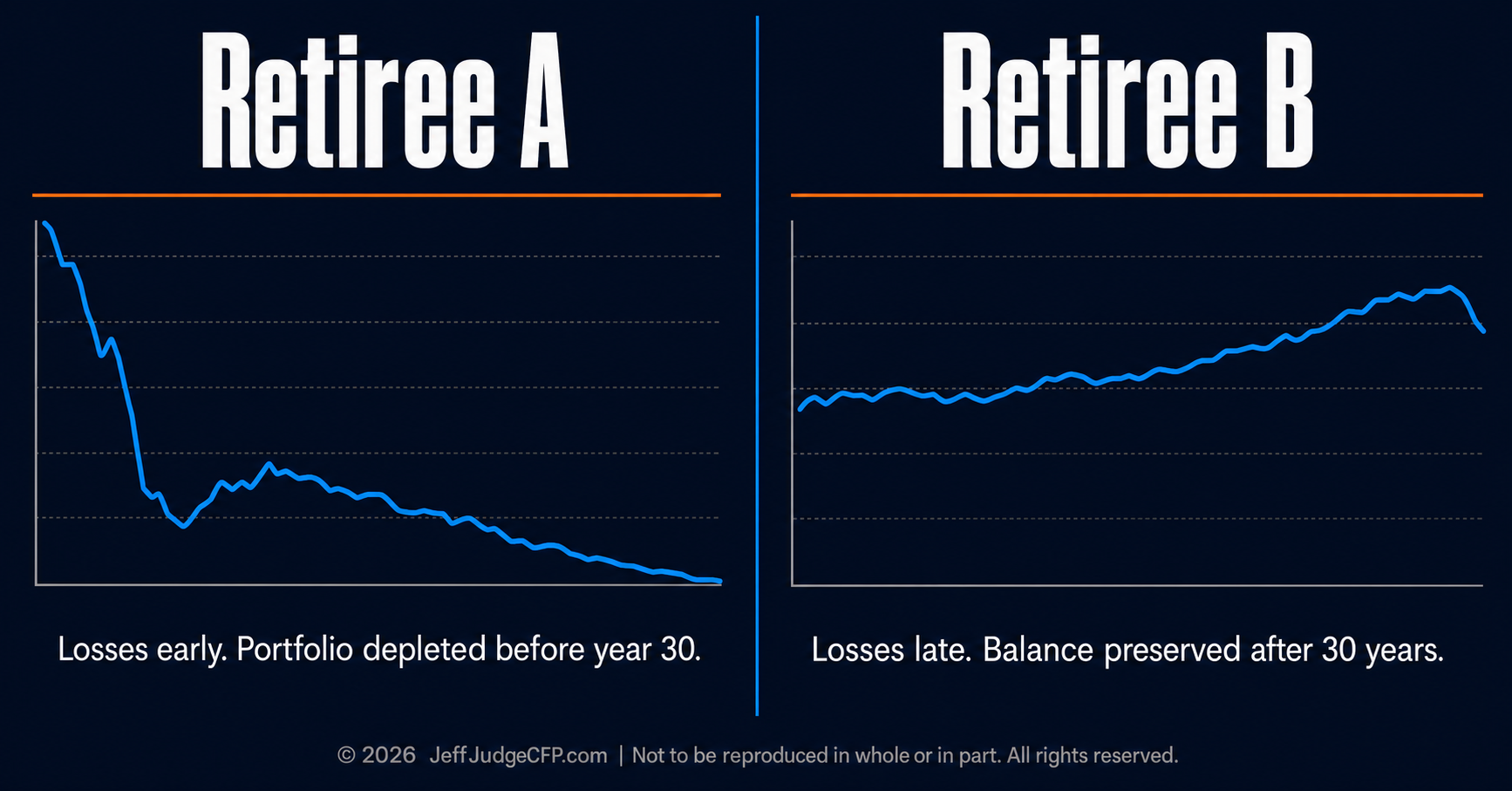
Retiree A experiences returns of negative 20%, negative 15%, then positive returns averaging 10% for the remaining 28 years.
Retiree B experiences the same sequence in reverse: strong returns for the first 28 years, then the two bad years at the end.
Retiree A may run out of money well before age 90. Retiree B will likely end with a larger balance than when they started. Same average return. Completely different outcomes. The only variable is when the losses occurred relative to the withdrawal schedule.
According to the Social Security Administration, the average retirement age in the U.S. is approximately 65. A 30-year retirement is a real planning horizon for many people, not an outlier scenario. The first decade of that 30-year window is where sequence risk has the greatest leverage on the outcome.
Why This Gets Ignored
Sequence of returns risk is hard to visualize and easy to wave off. When a financial projection shows an average annual return of 7% over 30 years, the bad scenarios are averaged into the number. The projection looks solid. What it doesn’t show is the distribution of outcomes depending on when the bad years arrive.
The planning industry has historically been better at selling optimism than surfacing downside scenarios. A projection built around average returns tells a smoother story than one that shows what happens if the first five years of retirement include a significant market decline.
Jeff runs sequence risk scenarios with clients as a standard part of retirement planning. Not to be alarmist. Because the decisions that matter, your withdrawal rate, your buffer strategy, your allocation transition, your Social Security timing, and your flexibility around spending, need to be made before retirement, not during the first bear market after it.
What to Do Before Retirement to Address Sequence Risk
There’s no single fix. Sequence risk is managed through a combination of decisions that collectively reduce the portfolio’s vulnerability to a bad early-return sequence:
- Build 12 to 24 months of living expenses into a cash or short-duration buffer before you retire
- Evaluate whether a higher withdrawal rate can be reduced by delaying retirement, reducing spending, or optimizing Social Security timing
- Transition your asset allocation in the five years before retirement to reduce the percentage of equities exposed to the highest-risk withdrawal window
- Identify which spending categories are flexible and which aren’t, so you have a plan if you need to cut 10 to 15 percent in a down year
None of this is about predicting market timing. It’s about building a structure that doesn’t require perfect timing to survive a bad sequence.
The variable that determines whether your retirement works isn’t your average return. It’s whether your portfolio structure can survive the years when returns arrive in the worst possible order.
Schedule a no-obligation call with Jeff to run your retirement income strategy through a sequence of returns analysis.
,-
The information provided is for educational purposes only and should not be construed as investment advice. Investment strategies should be tailored to individual circumstances, risk tolerance, and goals. Past performance doesn’t guarantee future results. Consult with qualified financial professionals regarding your specific situation.
Securities offered through LPL Financial, Member FINRA/SIPC. Investment advice offered through Great Valley Advisor Group, a registered investment advisor and separate entity from LPL Financial.
© 2026 JeffJudgeCFP.com | Not to be reproduced in whole or in part. All rights reserved.
§