



Most investing advice is about what to do. Almost none of it is about when. And timing, not in the market-timing sense, but in the sense of sequencing financial decisions correctly relative to your life stage, is where a significant amount of value gets lost or created.
The most consistent timing mistake Jeff sees: people applying accumulation strategies during the preservation phase, and preservation strategies during the accumulation phase. The strategies aren’t wrong in the abstract. The timing is wrong.
When does timing matter more than strategy?
The Roth vs. traditional decision is primarily a timing decision. Whether to contribute to a Roth or a traditional account is not a question of which account type is better. It’s a question of when your tax rate is lower, now or in retirement. Per the IRS, the 2026 marginal tax brackets run from 10% to 37%. If you’re currently in the 22% bracket and expect to be in the 32% bracket when you retire, the Roth wins. If you expect the reverse, the traditional account wins. The strategy is identical. The timing determines the outcome.
Tax-loss harvesting works better in some years than others. Harvesting investment losses to offset gains is a legitimate tax management technique. But per IRS rules, the $3,000 annual ordinary income deduction limit means large capital loss carryforwards often take years to fully utilize. Generating losses in a year when you have no offsetting gains may be less valuable than generating them in a year when you have a large concentrated position sale, a business transaction, or another significant capital event. The strategy is sound. The timing changes the value.
Equity compensation vesting and exercise timing can be more valuable than investment allocation. For people with significant unvested RSUs or stock options, the decision of when to exercise, which grants to prioritize, and how to handle the tax event from vesting often has more financial impact than the portfolio allocation below it.
The early retirement timing window most people ignore
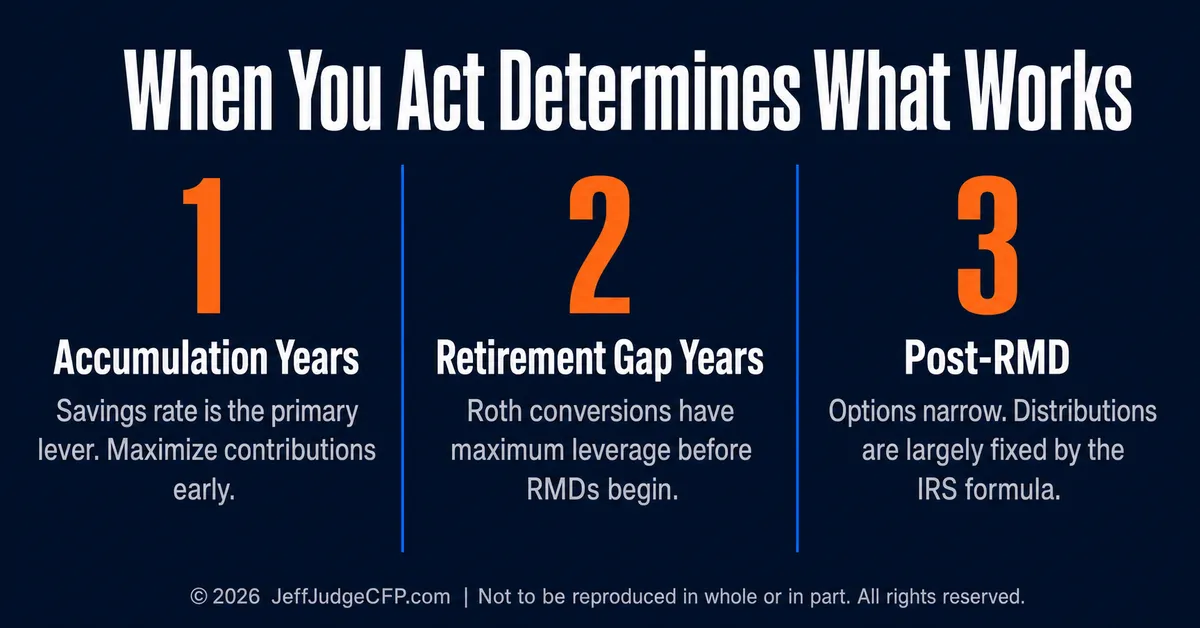
The period between early retirement and age 73, when RMDs begin, is one of the most financially leveraged windows in most people’s financial lives. Income in this period can often be managed more intentionally than at any other time.
Roth conversions in this window take advantage of lower income in early retirement to prepay tax at a lower rate before forced distributions begin. Per the IRS, required minimum distributions begin at age 73 using the life expectancy factor from Publication 590-B. A person who retires at 62 has 11 years to execute conversions before the RMD schedule takes over and income becomes less manageable.
Social Security claiming timing affects every year of retirement income permanently. Per the Social Security Administration, delaying from age 62 to 70 increases the monthly benefit by roughly 77% for someone born after 1960. That’s a permanent difference. The decision of when to claim interacts with Roth conversion timing, Medicare IRMAA thresholds, and withdrawal sequencing in ways that require planning before retirement, not after.
The timing mistake Jeff sees most often
People in their peak earning years, the 40s and early 50s, who are prioritizing conservative investment strategies because they’re getting closer to retirement. The logic feels sound: preserve what you’ve built. The practical consequence is that they’re applying a preservation mindset to capital that still has 15 to 25 years of compounding ahead of it.
A 48-year-old who shifts to a 40% equity allocation because retirement “feels close” may be making that shift 10 to 15 years early. The sequence of returns risk that justifies a more conservative allocation applies to the early years of withdrawal. Not to the years of accumulation 15 years before the first withdrawal.
The Bureau of Labor Statistics data shows the median retirement age in the U.S. sits around 62 to 65 for most workers. A 48-year-old who plans to retire at 63 still has 15 years of compounding ahead of them. The capital in their portfolio today needs to work hard for another decade and a half before preservation logic applies to most of it.
Schedule a no-obligation call with Jeff to review whether your current strategy is timed correctly for where you actually are in the accumulation-to-distribution cycle.
,-
The information provided is for educational purposes only and should not be construed as investment advice. Investment strategies should be tailored to individual circumstances, risk tolerance, and goals. Past performance doesn’t guarantee future results. Consult with qualified financial professionals regarding your specific situation.
Securities offered through LPL Financial, Member FINRA/SIPC. Investment advice offered through Great Valley Advisor Group, a registered investment advisor and separate entity from LPL Financial.
© 2026 JeffJudgeCFP.com | Not to be reproduced in whole or in part. All rights reserved.
§