



Delaying Social Security to age 70 raises your monthly benefit by 24% compared to claiming at full retirement age, per the Social Security Administration. That’s real money. But the math most people skip is the one that runs in the other direction: every month you delay is a month of benefits you don’t collect. The question isn’t whether delaying pays off in theory. It’s whether it pays off for you, in your lifetime.
What the SSA’s Numbers Actually Say
Per the Social Security Administration, someone born in 1960 or later who waits until 70 receives 124% of their full retirement age benefit. Filing at 62 reduces it to roughly 70%. The spread is meaningful. If your FRA benefit is $2,000 per month, claiming at 70 gets you $2,480. Claiming at 62 gets you about $1,400. That’s a $1,080 monthly gap.
What gets less attention: to capture the lifetime value of delay, you have to live long enough. And the math on that is straightforward once you actually run it.
FAQ: The Social Security Breakeven Questions Most People Have
When does delaying Social Security pay off?
Delay pays off when you live past the breakeven age, which is the point where cumulative lifetime benefits from waiting equal cumulative lifetime benefits from claiming earlier. For most people comparing ages 62 and 67, the breakeven falls somewhere in the late 70s. Comparing 67 to 70, it typically lands around age 80 to 82.
What is the Social Security breakeven age?
The breakeven depends on your specific benefit amounts. A rough way to calculate it: divide the total foregone benefits (the months you didn’t collect while waiting) by the monthly gain you earned from waiting. If delaying three years from 67 to 70 means forgoing $72,000 in payments ($2,000 per month for 36 months) to gain $480 per month, divide $72,000 by $480. That’s 150 months, or about 12.5 years. You’d break even at age 82 and a half.
What does delaying Social Security cost in the short term?
Every year of delay is a year of benefits not collected. At the average 2026 monthly Social Security benefit of $2,071, per the Social Security Administration, one year of delay costs about $24,850 in foregone payments. Eight years of delay from 62 to 70 is roughly $134,000 not collected before you begin receiving a higher check.
The Problem With “You’ll Live to 90”
Most advocates for delaying Social Security anchor the argument on longevity. The reasoning sounds bulletproof: Social Security is longevity insurance, and if you live to 95, the higher benefit pays off dramatically.
That’s a real consideration. It’s not the whole calculation.
The SSA’s actuarial tables indicate a man reaching age 62 in the U.S. has an average life expectancy of about 82. A woman reaching 62 averages about 85. Those are averages. Half the population lives shorter. If your health history, family history, or current health status puts you on the shorter side of that distribution, the “delay to maximize” argument weakens considerably.
There’s also the opportunity cost that rarely gets discussed: if you delay from 62 to 70, you forgo eight years of benefits. At roughly $1,400 per month for a person with an FRA benefit of $2,000, that’s about $134,000 not collected. If those payments had been invested even conservatively, they’d have compounded during the same period. The math isn’t just about monthly benefit amounts.
https://res.cloudinary.com/dmfujved8/image/upload/v1778785637/uc_z9dask.png
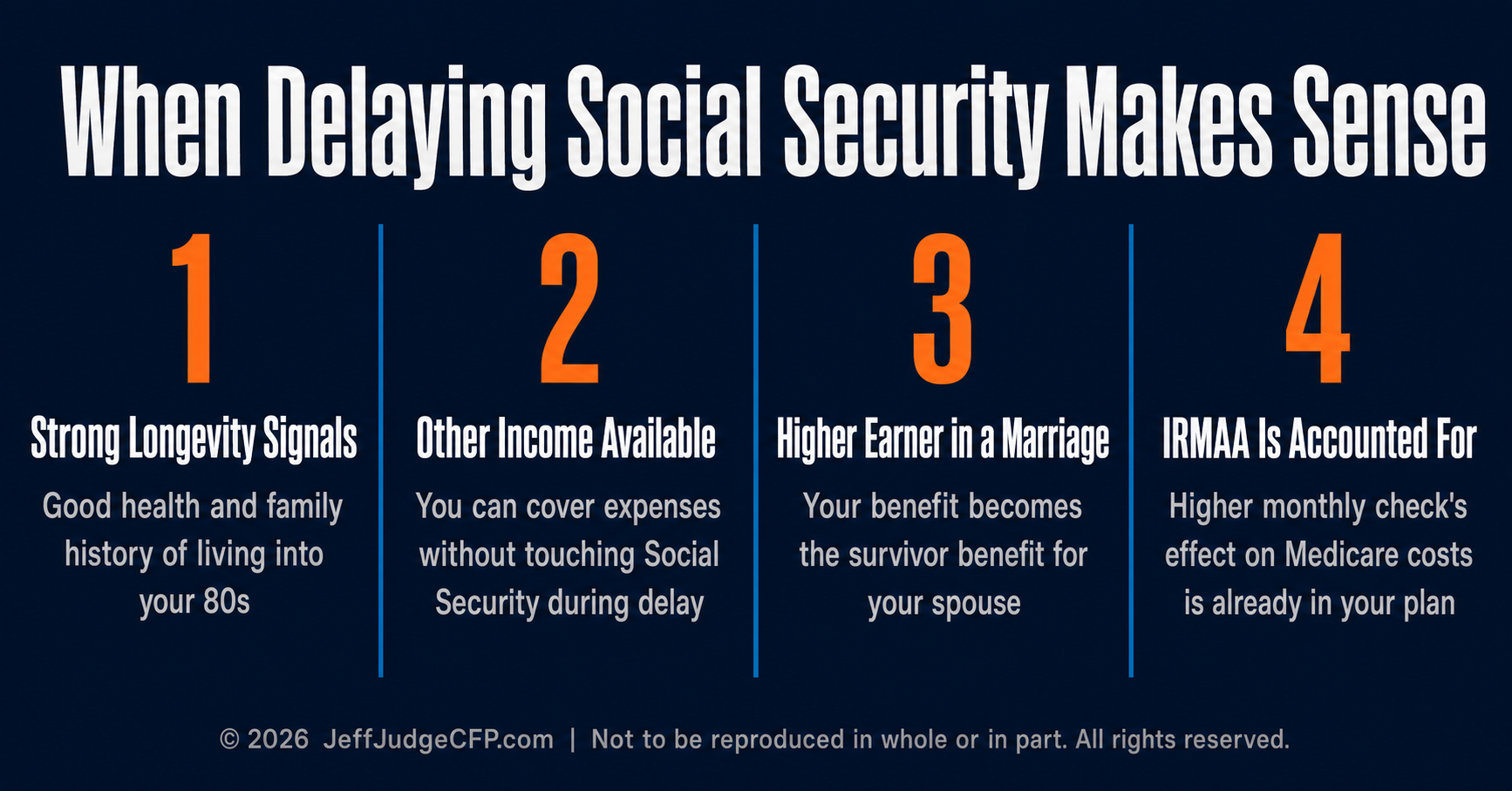
When Delaying Social Security Makes Sense
Delay is generally the right call when:
- You’re in good health with strong longevity indicators, including family history of living well into your 80s
- You can cover living expenses from other sources without touching Social Security during the delay years
- You’re the higher earner in a married couple, because your benefit becomes the survivor benefit
- Your tax situation in later years is accounted for, including how a higher monthly check interacts with Medicare’s IRMAA surcharges
The last point trips people up consistently. A higher Social Security benefit raises your income floor. For some people, that pushes a greater portion of Social Security into taxable territory under IRS combined income thresholds. It also affects Medicare Part B and Part D costs starting two years after the income is reported. The decision isn’t just about monthly checks. It’s about where those checks land in your overall income picture.
What the Right Answer Actually Requires
Jeff doesn’t have a blanket answer on Social Security timing, and you should be suspicious of anyone who does. “Always delay to 70” is not financial planning. It’s a rule of thumb dressed up as advice.
The right answer requires four things: your projected benefit at each claiming age (pull this from SSA.gov directly), your realistic health and longevity picture, your other income sources and how they interact with Social Security year by year, and a breakeven calculation run with your actual numbers.
That calculation is not complicated. It takes about 20 minutes with a spreadsheet or a planning tool. What it requires is someone willing to run the honest version, including the scenario where claiming early was the right call.
The math nobody does is the one that might tell you waiting cost you money. Run it before you decide.
Schedule a no-obligation call with Jeff to run the breakeven numbers for your specific situation.
,-
The information provided is for educational purposes only and should not be construed as investment advice. Investment strategies should be tailored to individual circumstances, risk tolerance, and goals. Past performance doesn’t guarantee future results. Consult with qualified financial professionals regarding your specific situation.
Securities offered through LPL Financial, Member FINRA/SIPC. Investment advice offered through Great Valley Advisor Group, a registered investment advisor and separate entity from LPL Financial.
© 2026 JeffJudgeCFP.com | Not to be reproduced in whole or in part. All rights reserved.
§