


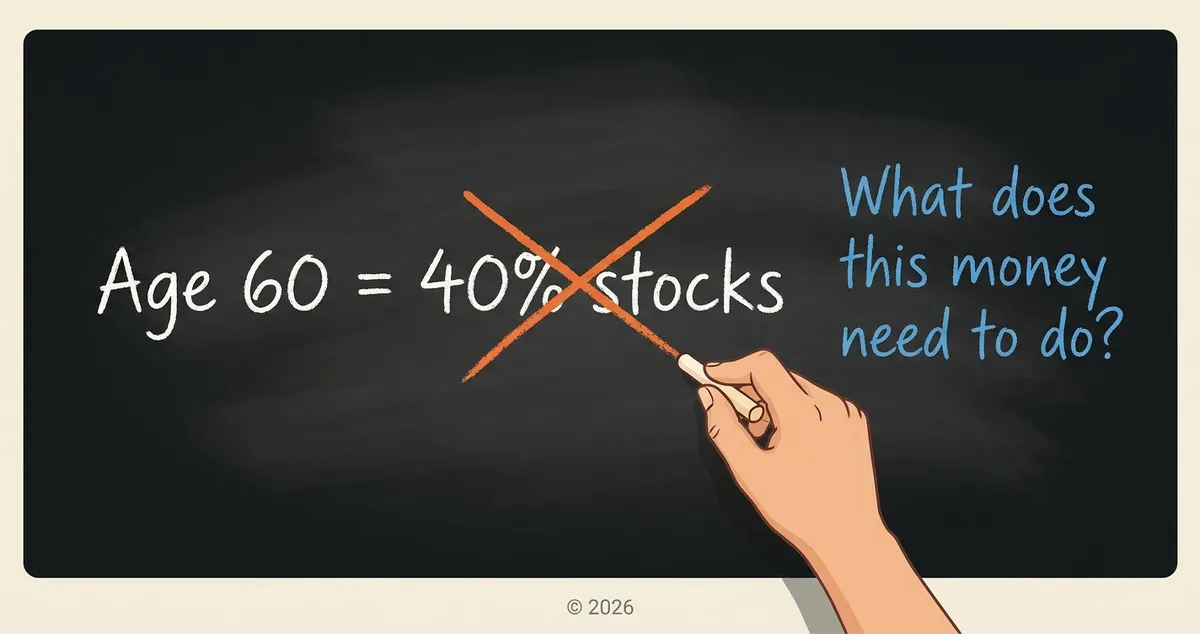
The age-based asset allocation formula has been embedded in retirement planning advice for decades. 100 minus your age in stocks. Or 110 minus your age. Or 120 minus your age, as the formula has evolved with longer life expectancies. The premise is that your risk exposure should automatically decline as you age, producing a progressively more conservative portfolio that protects your accumulated wealth as retirement approaches.
This is a rule of thumb masquerading as a financial plan. And for many people, especially high earners with substantial assets and long time horizons, it’s pointing in the wrong direction.
Why age-based asset allocation doesn’t work as a rule
What it gets right: The general direction. As you approach the period when you need to draw on your portfolio, having less of it in volatile assets reduces sequence of returns risk. That part is sound logic.
What it gets wrong: The starting assumption that age determines risk tolerance. Two 60-year-olds with the same age have wildly different financial situations. One has a pension covering most of their income need and a portfolio they won’t touch for 15 years. The other has no pension, plans to retire in three years, and the portfolio is their primary income source. The formula says they should have identical allocations. They shouldn’t.
The longevity problem: The Social Security Administration reports a 65-year-old today has approximately a one-in-three chance of living to 90. A couple where both are 65 has better than a 50% chance that at least one reaches 90. Per the formula, a 65-year-old in 1950, with an average life expectancy of about 78, might have reasonably held 35% in equities. A 65-year-old today planning for a 30-year retirement may need substantially more equity exposure to avoid running out of money.

The specific ways the formula fails high earners
High earners who retire early are the clearest case where the formula breaks down. Someone who retires at 58 and follows age-based allocation holds 42% equities (using the 100 minus age formula). But they have a 30 to 35 year time horizon and likely no pension. They need growth. A 42% equity allocation in year one of a 35-year retirement is dangerously conservative.
High earners with significant other income sources represent the opposite problem. A 68-year-old with a pension, Social Security, and rental income that covers their entire spending need has zero forced reliance on their investment portfolio for near-term income. The formula says 32% equities. But this person’s portfolio doesn’t need to provide income, it needs to preserve and grow wealth for heirs or late-stage care. An equity allocation considerably higher than 32% may be entirely appropriate.
Investment accounts held for estate planning purposes should not be allocated based on the owner’s age. If the portfolio is intended to pass to the next generation, the relevant time horizon is not the owner’s remaining life expectancy. It’s the heir’s.
What should determine your allocation instead
Four factors replace age as the meaningful inputs: how much of your annual income need your portfolio must cover (versus guaranteed income sources), when you will first need to draw significantly from the portfolio, what your actual risk tolerance is when you stress-test it against a real 30% decline scenario, and what the portfolio is intended to do after your death.
A person with pension and Social Security covering 100% of their income need can hold a high equity allocation throughout retirement. A person whose portfolio is the primary income source needs more bond exposure to buffer against sequence risk in the early withdrawal years. Neither answer has anything to do with age.
Age is a convenient proxy for these inputs because it’s a single number that’s easy to look up. It’s a poor proxy because it ignores everything that actually determines how your portfolio should behave.
Schedule a no-obligation call with Jeff to build an allocation based on your actual situation rather than a formula that doesn’t know anything about you.
,-
The information provided is for educational purposes only and should not be construed as investment advice. Investment strategies should be tailored to individual circumstances, risk tolerance, and goals. Past performance doesn’t guarantee future results. Consult with qualified financial professionals regarding your specific situation.
Securities offered through LPL Financial, Member FINRA/SIPC. Investment advice offered through Great Valley Advisor Group, a registered investment advisor and separate entity from LPL Financial.
© 2026 JeffJudgeCFP.com | Not to be reproduced in whole or in part. All rights reserved.
§