



Last reviewed: July 2026
Everyone in personal finance is optimizing their asset allocation. Checking the stock-to-bond ratio. Rebalancing toward the target. Debating whether to tilt toward small-cap value or factor-weight the international exposure. Meanwhile, most of these same people have never done a systematic audit of the fees running through their financial picture.
That’s the optimization problem worth solving first. And it’s not close.
Key Takeaways
- Most investors fine-tune asset allocation while never auditing the fees draining their portfolio.
- Per FINRA, a 0.10% vs 1.0% fund over 20 years on $300,000 can differ by more than $100,000.
- Fee drag compounds: at 7% gross on $300,000, the 30-year gap from 0.05% to 1.50% exceeds $680,000.
- Allocation tweaks like 60/40 versus 65/35 move outcomes far less than the fee differential does.
- Per the SEC, all-in variable annuity costs can run 2 to 3% a year, often on assets already tax-advantaged.
About the Author
About the Author: Jeff Judge, CFP®, AEP®, ChFC®, CLU® is a financial planner who writes Viewpoints for JeffJudgeCFP.com. He helps families and business owners audit the total cost of ownership across every account before fine-tuning a single allocation, using the R.U.D.D.E.R. Method™, the financial planning process Jeff developed. “The allocation differences people love to debate move outcomes by basis points. The fee structure can move them by hundreds of thousands of dollars.”
What does portfolio over-optimization actually cost?
The fees running through a portfolio are not a rounding error. Per FINRA investor education data, the difference between a 0.10% expense ratio index fund and a 1.0% actively managed fund — held for 20 years on a $300,000 starting balance — can exceed $100,000 in compounded difference. That’s not a return difference from asset allocation. It’s a tax from an administrative choice that most investors made once at account opening and never revisited.
The table below shows how fee drag compounds over time across common expense ratio levels.
| Starting Balance: $300,000 | 0.05% Expense Ratio | 0.50% Expense Ratio | 1.00% Expense Ratio | 1.50% Expense Ratio |
|---|---|---|---|---|
| After 10 years (7% gross) | $583,000 | $560,000 | $537,000 | $516,000 |
| After 20 years (7% gross) | $1,135,000 | $1,046,000 | $963,000 | $886,000 |
| After 30 years (7% gross) | $2,208,000 | $1,957,000 | $1,727,000 | $1,524,000 |
| 30-year gap vs. 0.05% | — | $251,000 | $481,000 | $684,000 |
Assumes 7% gross annual return before expenses. For illustration only. Does not account for taxes or inflation.
The behavioral gap compounds things further. Per the SEC, actively managed funds underperform their benchmark indices after fees in the majority of 10-year and 20-year measurement periods. And the typical investor in those funds underperforms the fund itself — because they buy after strong runs and sell after drawdowns. The alpha most people are chasing through allocation optimization is, after all costs and behavior are counted, often negative.
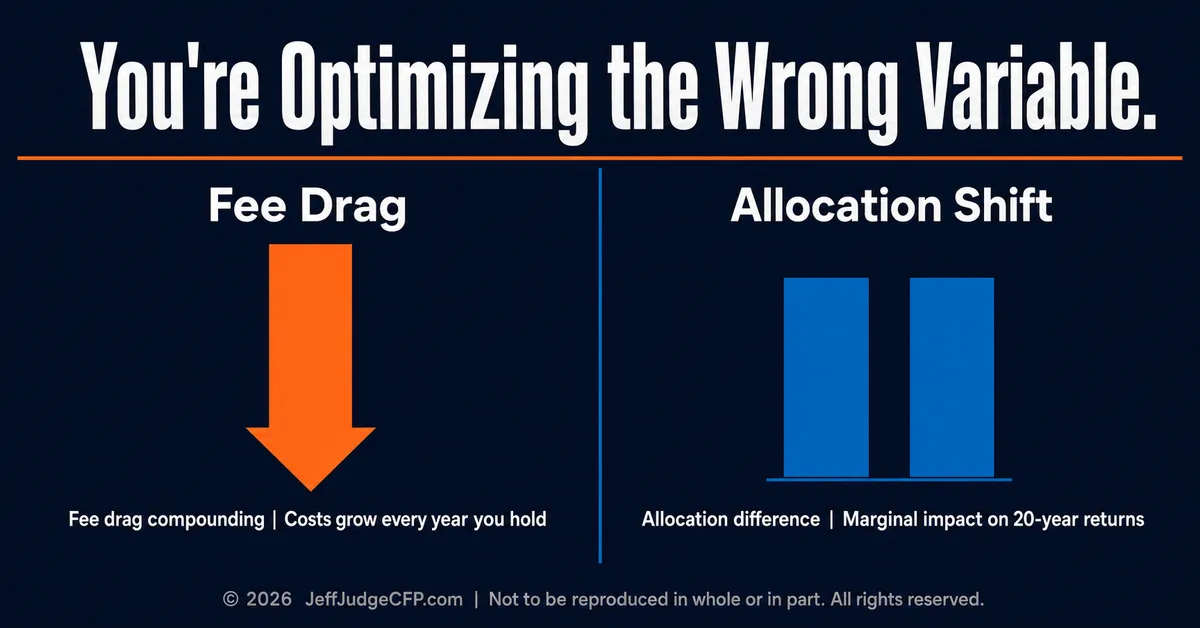
The allocation differences most investors actually debate — 60/40 versus 65/35, slight tilts toward international developed markets, adding a small-cap factor — produce marginal variance in long-run outcomes. The fee structure produces variance that can exceed a quarter-million dollars over a typical accumulation period. These are not equivalent levers.
Do fees really matter more than asset allocation?
For the choices most investors actually make, yes. Shifting 60/40 to 65/35 changes long-run outcomes by basis points. A one-point fee difference, per FINRA, can exceed $100,000 over 20 years on a $300,000 balance. Allocation matters broadly, but the small tweaks people obsess over move far less than fees.
Why do people optimize allocation instead of fees?
Allocation feels like investing. It involves analysis, research, and decisions that feel like applied expertise. Fees feel like an administrative matter — something that someone else should handle, or that doesn’t change that often, or that’s already been addressed.
This is exactly backwards from where the leverage sits.
Allocation optimization is emotionally satisfying. You’re “managing” something. You’re being active and attentive. Fee optimization involves admitting you may have been overpaying, having a direct conversation about expenses, or moving accounts — all of which feel harder than adjusting a slider.
The other reason: fees aren’t visible the same way returns are. You see your portfolio balance every time you log in. You don’t see a line item that says “annual fee drag: $4,800.” The money disappears quietly from returns that were never credited in the first place.
What does the fee audit most people skip look like?
The audit starts with investment expense ratios. Pull the expense ratio on every fund you own across every account — 401(k), IRA, taxable brokerage. Anything above 0.50% per year deserves a direct question: what is this fund providing that a 0.05% index fund in the same asset class doesn’t?
Account-level advisory fees come next. If you pay an AUM-based advisory fee, calculate what you’re paying in actual dollars per year. A 1% fee on a $600,000 portfolio is $6,000 annually. That’s the minimum the relationship needs to justify — in tax savings, behavioral coaching, planning services, or risk management. If you can’t articulate $6,000 worth of annual value, the fee structure warrants a conversation.
Insurance product fees often go unexamined longest. Variable annuities, permanent life insurance with cash value, and indexed products carry mortality and expense charges, administrative fees, and rider charges that don’t appear on investment statements. Per the SEC, the total annual cost of a variable annuity can run 2 to 3% annually when all layers are counted — and those costs compound on assets that may already sit inside a tax-advantaged account.
Which fees are most often overlooked?
The layered ones inside insurance products. Per the SEC, a variable annuity can carry 2 to 3% in total annual cost once mortality, administrative, and rider charges are added. Those fees rarely show up on an investment statement, so they keep compounding quietly while the obvious expense ratios get all the attention.
| Fee Category | Typical Range | Often Examined? | Practical Impact |
|---|---|---|---|
| Index fund expense ratios | 0.03–0.10% | Yes | Low — already minimal |
| Active fund expense ratios | 0.50–1.25% | Sometimes | High — compounds significantly |
| AUM advisory fee | 0.50–1.50% | Rarely | High — paid on entire portfolio |
| Variable annuity charges | 1.50–3.00% total | Almost never | Very high — often invisible |
| 401(k) plan administration | 0.10–1.00% | Almost never | Moderate — depends on plan |
Ranges reflect common market levels. Individual fees vary. Source: SEC, FINRA investor education resources.
The fees that are examined least tend to be the ones with the greatest compounding impact.
Frequently Asked Questions
Do investment fees matter more than asset allocation?
For the decisions most investors actually face, yes. Per FINRA, a 0.10% versus 1.0% fund held 20 years on $300,000 can differ by more than $100,000. The 60/40 versus 65/35 debates people spend time on move outcomes far less than that fee gap does.
How much does a 1% fee cost over time?
More than it looks, because it compounds. On a $300,000 balance at 7% gross, moving from a 0.05% to a 1.50% cost cuts the 30-year result by over $680,000. Even a single point of fee drag quietly removes six figures from a typical accumulation period.
How do you run a fee audit on your portfolio?
Pull the expense ratio on every fund across all accounts and question anything above 0.50%. Convert any advisory fee to dollars; 1% on $600,000 is $6,000 a year. Then check insurance products, where variable annuity costs can reach 2 to 3% annually.
Which investment fees are easiest to miss?
The invisible, layered ones. Index expense ratios are easy to see, but AUM advisory fees, 401(k) plan administration charges, and the mortality, administrative, and rider charges inside annuities and permanent life insurance rarely show up on a statement, so they compound for years before anyone questions them.
What does the right sequence of financial priorities look like?
Before debating 60/40 versus 70/30, audit the fees. Before considering adding international small-cap exposure, calculate what you’re currently paying across all accounts in dollars, not percentages. Before optimizing any allocation variable, understand the total annual cost of ownership of your existing financial products.
The contrarian position here isn’t that allocation doesn’t matter — it does. The academic research is clear that asset allocation accounts for a substantial portion of long-run return variance. But the allocation differences most investors are actively debating produce a few basis points of marginal difference. The fee structure produces a difference that can exceed $500,000 over a 30-year accumulation period on a mid-sized portfolio.
Stop optimizing your asset allocation. Start auditing your costs.
Schedule a no-obligation call with Jeff to find out whether fees or allocation is the bigger drag on your portfolio.
The information provided is for educational purposes only and should not be construed as investment advice. Investment strategies should be tailored to individual circumstances, risk tolerance, and goals. Past performance doesn’t guarantee future results. Consult with qualified financial professionals regarding your specific situation. Securities offered through LPL Financial, Member FINRA/SIPC. Investment advice offered through Great Valley Advisor Group, a registered investment advisor and separate entity from LPL Financial. © 2026 JeffJudgeCFP.com | Not to be reproduced in whole or in part. All rights reserved.